Car Accidents
What Do Car Crash Lawyers Do in New York? A Construction Worker’s Decision Guide
Start with the decision behind the lawyer question
The decision to contact a New York car crash lawyer should turn on the unresolved issues in your crash, not only on how damaged the vehicles look. A consultation may examine fault, causation, your injuries, resulting losses, insurance, and the records available to support those questions. A crash that appears minor may still involve an injury, missed work, medical bills, disputed responsibility, or an insurer request that deserves careful attention.
A practical decision path is to:
- identify what remains uncertain about how the crash happened;
- separate vehicle damage from injury, treatment, and work-impact questions;
- preserve documents, witness information, medical records, and insurer communications;
- consider timing before evidence becomes harder to gather or a filing requirement becomes urgent; and
- use a consultation to learn which questions require legal review.
That process does not predict whether you have a viable case or what it may be worth. It gives you a more useful basis for deciding whether legal guidance fits your situation.
What a car crash lawyer actually reviews
A New York car crash lawyer reviews the connection between the crash, the other party’s conduct, your injuries, and your losses. A consultation may examine whether another party breached a duty of care, whether that conduct caused the claimed injuries, how damages can be quantified, and what insurance or other assets may be available for recovery. Those are separate questions. A clear account of the collision does not by itself establish the medical or financial parts of a claim.
A lawyer may also review the practical record surrounding the crash. That work can include identifying missing documents, assessing witness information, handling insurer communications, and explaining the choices available in your circumstances. After representation begins, an insurer may communicate with the lawyer instead of directly with you, and the lawyer may review requests for a recorded statement or medical authorization. You still need to send insurer letters, emails, and forms to your lawyer promptly rather than ignoring them.
A lawyer may also discuss whether the available record supports continuing an insurance claim, seeking additional information, or considering litigation. In a New York serious-injury review, gathering medical records, treatment information, diagnostic tests, and related bills may help clarify the legal options. The consultation does not turn every disagreement with an insurer into a lawsuit. It helps place the disagreement in the right category: proof, coverage, timing, fault, injury, or another issue that needs closer review.
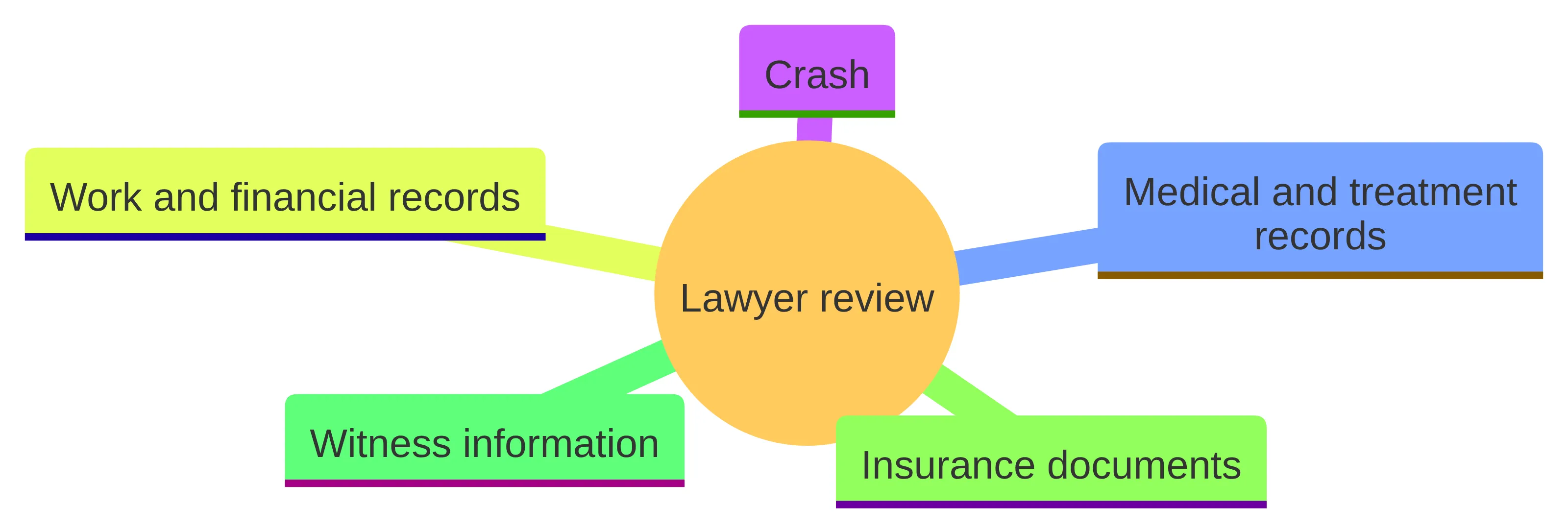
The lawyer’s review is therefore a sequence of connected questions rather than a single judgment about who was at fault. The crash account addresses what happened. Medical and treatment records address the injury question. Work and financial records address resulting losses. Insurance documents show what requests, responses, or coverage questions remain open. Keeping those categories distinct helps you understand what information a lawyer may need before discussing whether a claim should proceed.
Use the crash profile to choose a path
Your crash profile can show whether a legal consultation may be useful without deciding your eligibility. Consider the facts that change the questions a lawyer may need to review:
- an injury, continuing treatment, or medical bills;
- missed work;
- fault that the other driver, insurer, or witness disputes;
- more than one vehicle or a government vehicle;
- a business, construction area, or defective road condition connected to the crash; or
- a record that is incomplete, inconsistent, or becoming harder to obtain.
These circumstances do not establish liability or guarantee a result. They identify unresolved issues that may justify asking for legal guidance.
A minor crash without injuries or with minimal property damage may be manageable without an attorney’s assistance, according to one New York legal source. The path changes if you have even a seemingly minor injury: seek medical care and consider obtaining a personal-injury lawyer’s opinion before making decisions about the case. Medical attention addresses your health; a legal consultation addresses the record, insurance questions, and available choices. Keep those functions separate.
Your direct action is to classify the unresolved issue before choosing a path. If the only remaining question concerns property damage in a genuinely minor, injury-free crash, you may be able to handle the insurance dispute yourself. If injury, work disruption, disputed fault, multiple vehicles, or an unusual roadway or vehicle is involved, gather the available records and consider a consultation before making a final case decision.
The same facts can point to different questions. Missed work raises a loss-documentation issue; disputed fault raises a proof issue; several vehicles raise a responsibility issue; and a construction area or business vehicle may add another party or record to identify. Write down the issue that applies to you, then bring that question to counsel instead of assuming that the crash profile alone decides the legal outcome.
Treat injuries and work disruption as separate questions
Injury questions and work-disruption questions measure different parts of a crash’s impact. Your medical record can show treatment, diagnostic testing, bills, and the course of the injury. Your work record can show missed time and how the crash affected your ability to perform your job. A construction worker may need to preserve both records because physical duties, treatment appointments, and time away from a job can create different facts for review.
Your action is to record each category separately rather than describing everything as a general loss. Keep medical documents together, then create a simple work-impact record with dates missed, work restrictions, appointments, and related communications. Do not use that list to calculate a legal recovery or decide that an injury meets a particular standard. Bring it to a lawyer so the medical and employment questions can be considered with the rest of the crash record.
The sequence also matters. Note when symptoms began, when treatment occurred, when you missed work, and whether work restrictions changed. Include diagnostic tests, bills, and information about continuing care with the medical materials. Keep shift records, employer communications, and restrictions with the work materials. This organization does not decide causation or the seriousness of an injury; it gives a lawyer a clearer timeline to review.
See the lawyer’s work as evidence management
Evidence management is a central part of what a New York car crash lawyer may do after an accident. The goal is not to collect every document without order. The goal is to connect each important question to the record that may help answer it.
A lawyer may organize material around:
- the collision: accident-related documents and your written account of what happened;
- the people: witness names and contact information;
- the injury: medical records, treatment information, diagnostic tests, and bills;
- the consequences: missed work and other records of resulting losses; and
- the dispute: insurer letters, emails, forms, settlement communications, or conflicting accounts.
A lawyer may review that material, identify missing records, and explain the choices available in your situation.
Your action is to preserve information in its original form where possible and write down what you remember while the sequence is available to you. Include dates, locations, people involved, medical visits, work interruptions, and communications. Do not change a document to make the story appear stronger. A reliable record is more useful than a polished account that leaves out uncertainty or conflicting details.
Delays can make it harder to gather evidence, preserve witness accounts, or meet filing requirements. That does not mean every missing item defeats a claim. It means you should not treat evidence collection as something that can always wait until the dispute becomes formal. Send relevant material to a lawyer promptly if you decide to seek legal guidance.
Use the record to expose questions, not to force an answer. If two accounts differ, preserve both and note who provided each one. If a medical bill or witness contact is missing, mark it as missing rather than filling the gap from memory. If an insurer’s request is unclear, keep the request with the rest of the insurance file. This gives counsel a way to identify what should be obtained, clarified, or addressed next.
Keep insurer communications from becoming an information gap
Insurer communications can create a separate review issue after a New York crash. An insurer may ask about the accident, your injuries, or your treatment, and may request a recorded statement or medical authorization. After representation begins, the insurer may communicate with your lawyer instead of directly with you. A lawyer can review those requests and explain whether responding is appropriate.
Your action is to forward insurer letters, emails, and forms to your lawyer promptly if you are represented. Do not assume that hiring a lawyer means you can ignore every insurance message. Missed deadlines or unanswered requests can create avoidable problems, while sending the communication to counsel keeps the request in the working record. Avoid discussing the crash publicly because social-media posts, photographs, or comments may be taken out of context when the seriousness of an injury is questioned.
Your action before representation is narrower: preserve each communication and avoid making a case decision based only on an insurer’s request. A consultation can place the request beside the medical, work, and accident records. Do not treat a general explanation of insurer communications as permission to ignore a particular deadline or document.
Keep a simple communication log with the date, sender, subject, and the document or request involved. Save the original message and any attached form. If you are represented, send the complete communication to your lawyer promptly rather than summarizing it from memory. This preserves the context counsel may need when explaining your available choices.
Separate timing from the merits
New York timing is a separate question from whether the facts support a claim. The NYC Bar’s table lists three years from the accident date to sue for a New York car-accident personal-injury case. That is general information, not a determination of the deadline for your circumstances. Different facts, parties, claim types, or procedural rules may require a lawyer to examine the timing more closely.
Your action is to record the crash date, preserve the papers that identify the parties and insurance, and raise timing at a consultation rather than waiting for the dispute to become urgent. The merits question asks what happened and what losses followed. The timing question asks what procedural window may apply. Delays can also make evidence and witness accounts harder to preserve, so do not use the general three-year listing as a reason to postpone organizing the record.
A filing period and the strength of a claim answer different questions. A claim may require review of fault, causation, injury, losses, and insurance even when the accident date is clear. Conversely, a possible claim should not lead you to assume that the same timing rule applies to every party or claim type. Put the accident date at the front of your file and ask counsel which timing questions require case-specific review.
How a New York car crash lawyer reviews the unresolved issues
In a New York car-crash consultation, the lawyer’s review may cover four connected questions: fault, causation, damages, and available insurance or assets. The lawyer may examine the accident account, medical documentation, treatment information, bills, work-impact records, and witness information to identify what supports those questions and what records are missing.
That review is not a prediction of an outcome. It is a way to explain the choices available in the circumstances and identify follow-up work.
A construction worker’s record may need a clear work sequence because the same crash can affect transportation, physical duties, treatment, and scheduled shifts. Keep employment records separate from medical records, then note where the dates overlap. If a construction area, business vehicle, government vehicle, or defective road condition may be connected to the crash, place that fact in the open-questions section rather than assuming it determines responsibility.
Your action is to bring what you have, including gaps and contradictions. A lawyer can identify missing records after reviewing the file. You do not need to solve fault, causation, damages, insurance, or timing before asking for legal guidance.
Use a consistent order for paper and electronic materials so you can find the same category quickly. Put the crash date and your main open questions at the front. Keep duplicate copies only when they help preserve different versions of a communication or record. Mark an item as pending when you are still waiting for it; do not delay a consultation until the file appears complete.
Prepare questions that make the consultation useful
A useful consultation gives you a chance to ask how the available record affects the next decision. Prepare questions such as:
- What facts about fault or causation need more support?
- Which medical, treatment, diagnostic, or billing records are missing?
- How should missed work and other resulting losses be documented?
- What insurer communications or forms require review?
- What timing issues should be addressed based on the crash date and the parties involved?
- What choices are available if the insurer disputes fault or the injury record?
- What information should you provide after the consultation, and when should you expect the next communication?
These questions seek a review of the record rather than a prediction. A lawyer may explain the available choices, but the consultation does not guarantee that a claim will be accepted or produce a particular result.
Fee questions belong in the consultation as well. Before proceeding with a personal-injury case, ask for a written fee agreement that clearly documents the fee arrangements. A lawyer evaluating a contingency-fee case may consider recovery prospects, the expected value of the work, and available payment sources before accepting it. Do not treat a general contingency-fee explanation as a promise that any lawyer will accept your case.
At Bergman, Bergman, Fields & Lamonsoff, LLP, we provide emotional and logistical assistance to people affected by accidents. We have more than 60 years of experience assisting car-crash victims. We emphasize personal and frequent one-on-one communication with our clients.
Use the consultation to leave with a clear list of next questions, documents, and timing concerns. Ask what information should be sent after the meeting and how future insurer communications should be handled. If you are considering proceeding, ask for the fee arrangements in writing before moving forward. A focused conversation should clarify what requires further review without turning general information into a prediction.
Choose a non-promissory next step
A New York car crash consultation can help you organize unresolved questions about fault, injuries, work disruption, insurance communications, evidence, and timing. Gather the record you already have, preserve insurer communications, and write down the questions you want answered. A qualified lawyer must decide whether legal guidance fits your circumstances after reviewing the relevant facts; general information cannot make that decision or predict an outcome.
Keep reading
More on Car Accidents
 Car Accidents
Car Crash Lawyers in New York: A Construction Worker’s Decision and Consultation Guide
Learn what car crash lawyers do in New York, when a consultation may help, and how to prepare your crash records.
Read article Car Accidents
Maximize Your Compensation After a Car Accident: Essential Steps
Maximize your compensation after a car accident with essential steps and legal support.
Read article Car Accidents
4 Steps to Find Someone’s Insurance Policy Number Easily
Learn how to find someone's insurance policy number with these four simple steps.
Read articleHurt like this?
Tell us what happened.
We handle Car Accidents cases across Long Island, Queens and New York City. The consultation is free and you pay nothing unless we win.
- Answered 24/7
- No fee unless we win
- Hablamos español
Send us the details
Takes about a minute. Free and confidential.