
Practice area

Slip and Fall / Premises Liability

Premises cases include slip, trip and fall accidents, ceiling collapses, injuries caused by fire, and injuries caused by inadequate security. When it comes to a premises case, our team has a proven record of navigating this area of law.

Free case review

Takes about a minute. Free and confidential.

Sending this does not create an attorney-client relationship.

  • No fee unless we win
  • Answered 24/7
  • Hablamos español

Notice: the word that decides these cases

A property owner is not automatically responsible because you fell on their property. To win, you generally have to show the owner either created the dangerous condition, or knew about it, or should have known about it because it had been there long enough to be found and fixed. That is what lawyers mean by notice, and it is where most premises cases are won or lost.

The deadline to know

On Long Island the rules vary by town and village, and a claim against a municipality often requires proof of prior written notice of the defect plus a Notice of Claim within 90 days.

  1. 01

    What proves notice is almost always something that will not exist in a month:

    the surveillance video that gets overwritten on a 14- or 30-day loop, the sweep log or inspection sheet that shows nobody had checked the aisle for hours, the prior complaints about the same broken step, the photograph of the puddle before anyone mopped it. This is why calling early is not a sales line in a premises case — it is the case.

  2. 02

    Snow and ice have their own rule. New York's "storm in progress" doctrine gives an owner a reasonable period after a storm ends to clear the property. Whether the storm had actually ended, and what the owner did in the hours after, decides winter cases. Certified weather records are ordinary evidence in this practice.

  3. 03

    Sidewalks depend on the address. In New York City, Administrative Code § 7-210 shifts responsibility for maintaining most sidewalks onto the adjoining property owner. Two falls on two sidewalks a mile apart can be governed by completely different law.

Where these falls happen

Stores and supermarkets

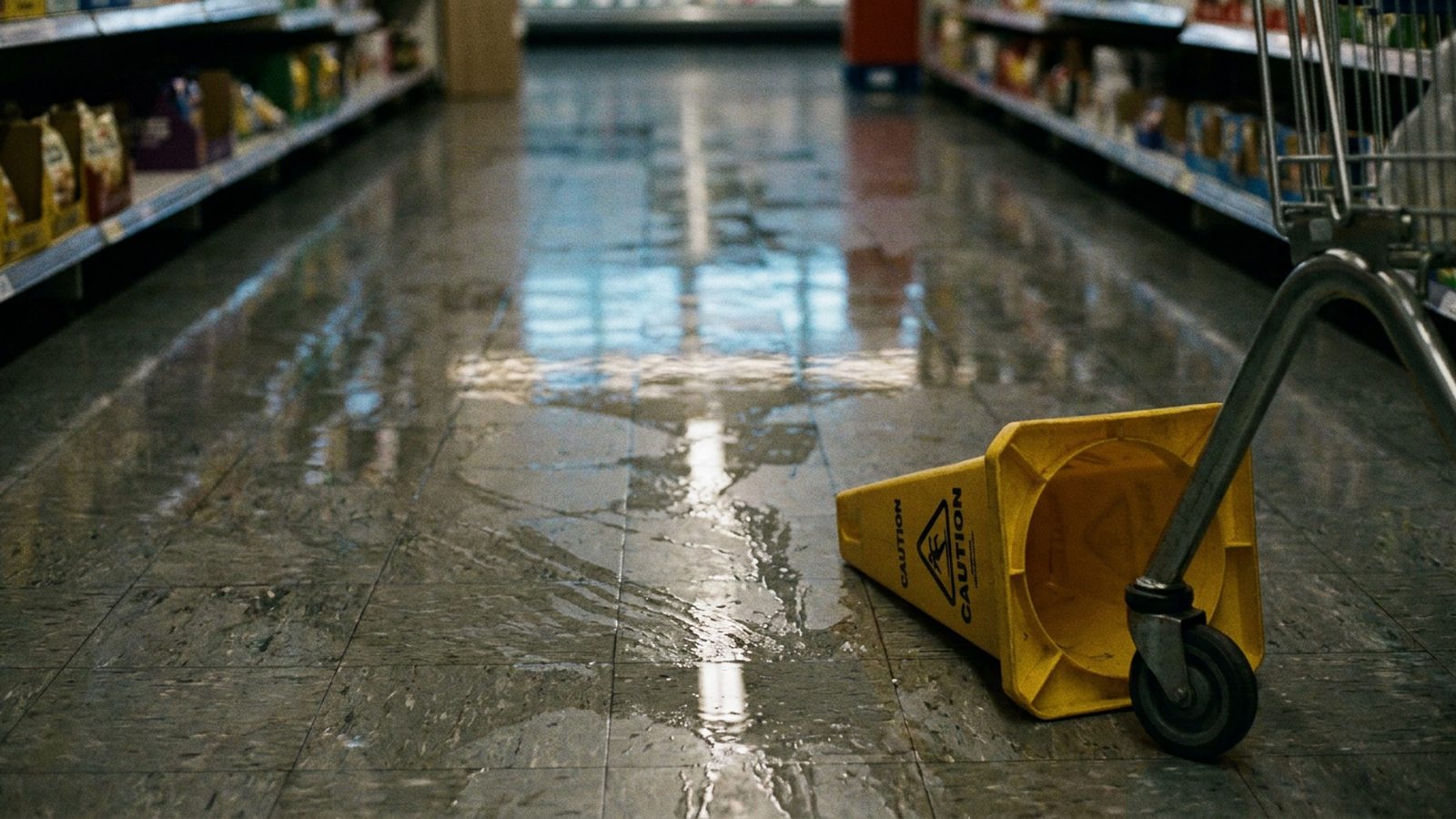
Spills, tracked-in rain, produce on the floor, freezer condensation. The sweep log and the video are the case. The firm recovered $1,450,000 for a man who tripped in a retail store parking lot and fractured his arm.

Stairs and stairwells

Missing handrails, worn treads, uneven risers, no light. Building-code violations turn a fall into a strong case. The firm recovered $1,000,000 for a man who fell down a defective staircase in his apartment building and sustained a spinal cord injury.

Ice and snow

Parking lots, walkways, entrances. Storm-in-progress, refreeze from bad drainage, and what the plowing contract required.

Sidewalks and parking lots

Broken flags, tree-root heave, potholes, unmarked level changes and wheel stops.

Apartment buildings and common areas

Lobbies, hallways, laundry rooms and elevators — including landlord liability for conditions the super knew about.

Ceiling collapses and building defects

Water damage, deferred repairs and violations on file with the building department.

Verdicts and settlements

Premises recoveries obtained by this firm

  • $7,500,000

    Verdict for wrongful death, against landlord, caused by fire that spread through apartment that was without smoke detectors.

  • $1,450,000

    For a man that tripped and fell in the parking lot of a retail store and fractured his left arm which required surgery.

  • $1,000,000

    For a man that fell down a flight of stairs due to defective conditions on the staircase in his apartment building causing a spinal cord injury.

  • $750,000

    Store worker that tripped on a pipe left by a contractor causing injuries to both her knees which required surgery.

  • $355,000

    For his client that slipped and fell on ice while installing a cell phone antenna on a rooftop sustaining injuries to his shoulder and forearm.

  • $175,000

    For his client who slipped and fell on a stairwell while attempting to exit a nightclub sustaining injuries to his head and mouth.

All results

Prior results do not guarantee a similar outcome. Every case is different, and the result in any case depends on its own facts.

The first 48 hours

What to do after a fall

  • Photograph the exact condition, from several angles, with something in frame for scale
  • Report it to the manager or super and ask for a written incident report — then ask for a copy
  • Get the names and numbers of anyone who saw it or who helped you up
  • Keep the shoes and clothing you were wearing, unwashed
  • Seek medical attention the same day; a gap in treatment is the first thing the defense points to
  • Call us before the video is overwritten — many systems keep only 14 to 30 days

Slip and fall questions

Not answered here? A lawyer will answer it, free and at any hour.

Ask us directly
The store says it was my own fault for not looking.
That is comparative fault, and in New York it reduces a recovery rather than barring it. A jury can find you 20% responsible and the store 80% responsible, and you still recover 80%.
Nobody made a report when I fell. Is my case over?
No — but it makes the other evidence more important. Video, witnesses, the medical records showing you presented that same day, and the store's own maintenance records all still exist. They just have to be secured quickly.
I fell on a public sidewalk. Who is responsible?
It depends on where. In New York City the adjoining property owner is usually responsible under Administrative Code § 7-210. On Long Island responsibility can rest with the municipality, and those claims normally require a Notice of Claim within 90 days and proof of prior written notice of the defect.
It was snowing when I fell.
Then the storm-in-progress rule is in play: the owner gets a reasonable time after the storm ends to clear up. Cases still succeed where the ice was old, where refreeze came from a downspout or bad drainage, or where the owner made the condition worse by plowing badly.
How long do I have?
Three years against a private owner. Ninety days for a Notice of Claim against a municipality, a housing authority or a public hospital — which is the deadline that catches people out.

From the blog

Latest articles on Slip & Fall

See all 21 articles

Free consultation

Hurt in a fall that was not your fault?

Call before the video is gone. The consultation is free and you pay nothing unless we win.