Construction Accidents
How to Choose a Nearby New York Personal Injury Law Firm After a Construction Accident

Start with the nearby-firm decision
Choosing nearby New York personal injury representation after a construction accident starts with three practical questions: does the practice handle the type of injury you experienced, is contacting an office workable from your location, and can you explain the accident and its effects clearly enough to begin a focused conversation? Those questions do not decide whether you have a claim. They help you decide whether an initial consultation is a sensible next step.
Bergman, Bergman, Fields & Lamonsoff, LLP handles personal injury cases involving auto accidents, construction-site accidents, product liability, medical malpractice, and fall accidents. Our Hicksville office is at 801 S. Broadway, and our Queens practice provides personal injury legal services to accident victims in Queens. Those facts give you a starting point for assessing subject-matter and location fit, not a conclusion about your individual matter.
Use this guide as a decision screen rather than a promise of an outcome. First, identify the event and injury category. Next, consider whether Hicksville, Queens, or another contact point is practical for you. Then assemble a short factual summary, prepare questions about experience, case management, communication, and pricing, and separate the cost of an initial consultation from the terms of any later representation. We offer free consultations for personal injury cases, so you can use that conversation to explain what happened and ask focused questions.
The decision does not need to be complicated. You can move through it in this order:
- Fit: Name the event in plain language, such as a fall, equipment incident, truck collision, or site-condition injury.
- Access: Identify which New York contact point is practical based on your location, treatment, mobility, records, and schedule.
- Readiness: Gather the dates, people, documents, symptoms, treatment information, and communications you already have.
- Questions: Write down what you need to understand about similar experience, management, communication, pricing, and timing.
If the practice area appears relevant and contact is practical, request a consultation even if some details remain incomplete. If a deadline, notice, or government entity appears in your records, raise that issue at the start rather than waiting for the end of the conversation.
Match the injury to the firm’s stated practice areas
The injury category is the first fit question because construction work can involve more than one kind of accident. Our stated practice areas include auto accidents, construction-site accidents, product liability, medical malpractice, and fall accidents. We also handle personal injury matters including truck accidents, construction accidents, and slip-and-fall cases. These descriptions identify areas we handle; they are not a complete legal classification of every possible construction event.
Describe the event in ordinary terms before trying to attach a legal label. You might have fallen from a scaffold or ladder, been struck by equipment, been involved in a truck collision, or suffered an injury involving a product or site condition. You do not need to decide which category controls before speaking with counsel. The useful first step is to connect the event, the injury, and the worksite setting in a short account.
A practical match check has four parts:
- Identify what caused the event: a fall, vehicle or truck incident, equipment or product problem, site condition, or another occurrence.
- Describe where the event happened and whether it was connected to construction work.
- List the injuries you know about, including symptoms that appeared after the accident.
- Note whether an employer, contractor, property owner, equipment company, driver, manufacturer, insurer, or government body has communicated with you.
This list does not assign responsibility. It gives you a usable description for an initial conversation. If your facts do not fit neatly into one category, say so rather than forcing the event into a label. A consultation can begin with the facts you know and the questions you still have.
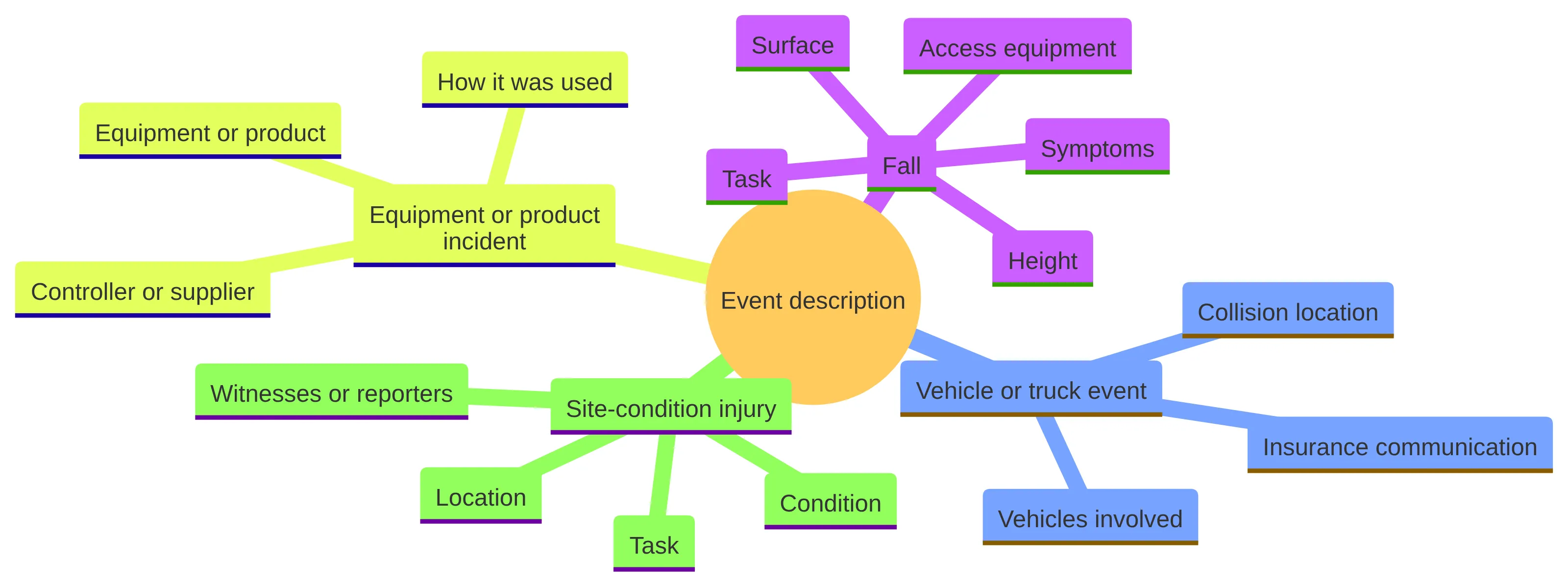
Use the event description to choose what to emphasize when you make contact:
- For a fall, record the surface, height, access equipment, task, and symptoms you noticed.
- For a vehicle or truck event, record the vehicles involved, where the collision occurred, and every insurance communication you received.
- For an equipment or product incident, identify the equipment or product, how it was being used, and who controlled or supplied it if you know.
- For a site-condition injury, identify the location, task, condition, and people who may have seen or reported it.
These branches organize your account; they do not select a legal theory. Bring the branch that best describes the event and explain any overlap during the consultation.
The practice-area match is a reason to make contact, not proof that a particular legal theory applies. A construction accident may raise questions about the worksite, equipment, transportation, medical treatment, or insurance communications at the same time. Keep those subjects together in your summary, and let the consultation address how they relate.
Overview
The nearby-firm decision becomes easier when you separate fit, convenience, preparation, and timing. Each factor answers a different question, and none should be used as a substitute for the others.
- Injury fit: Does the event resemble one of the personal injury matters we handle, such as a construction-site accident, truck accident, fall, auto accident, product-liability matter, or medical-malpractice case?
- Location fit: Is an office or contact point practical from where you live, work, receive treatment, or keep your records?
- Handling fit: What do you learn about who manages the matter and how communication will work? Every case we handle is managed by a partner, and we emphasize personal and frequent one-on-one communication with clients.
- Consultation readiness: Can you give a clear account of the event, injuries, treatment, work impact, and insurance communications while identifying the questions you want answered?
- Timing awareness: Has any date, notice, claim form, letter, or communication created a time-sensitive question that you should raise promptly?
Use the factors together. A convenient location does not answer an injury-fit question, and a practice-area match does not remove the need to discuss timing. The purpose of this screen is to help you make a deliberate contact decision with a factual starting point.
The consultation is a place to discuss the information you have, ask about experience with similar situations, ask how the matter would be managed, and ask about pricing structure. Prepare enough detail to make the conversation concrete, but do not wait for a perfect file. A short accurate account is more useful than a long account filled with guesses.
A simple worksheet can keep the factors separate. Put one sentence under each heading:
- What happened: State the event, worksite or roadway, and date.
- What followed: List the injuries, treatment, restrictions, and changes to work or daily activities.
- Where contact is practical: Note your location, treatment location, transportation limits, and where records are kept.
- What needs an answer: List your three most urgent questions, including any timing or notice concern.
Read the worksheet once before contacting the office. If it shows a clear practice-area connection, a workable contact option, and questions you want to discuss, you have a practical basis for requesting a consultation. The worksheet is a preparation aid, not a case evaluation.
Use New York office context as a convenience factor
The Hicksville office gives you a specific New York location to consider when Nassau County access is practical. Our Hicksville office is at 801 S. Broadway, minutes from the Nassau County Supreme Court in Mineola, and directly served by the Long Island Rail Road. Physical proximity can affect how easy it is for you to communicate, organize documents, and attend an office conversation, but it does not determine whether your case is suitable for consultation.
Queens location is another relevant factor when the accident, treatment, home, or work takes place there. We provide personal injury legal services to accident victims in Queens. If Queens is more practical for you than Nassau County, include that location in your initial contact and explain where you live, work, receive treatment, or keep the accident records.
Compare location by practical access rather than by distance alone. Consider:
- How you would travel if an in-person meeting became useful.
- Whether your work schedule, mobility, or medical treatment makes travel difficult.
- Where accident reports, medical records, photographs, and insurance correspondence are located.
- Whether another person helping you can reach the same location or participate in communication.
You do not have to treat an office address as a legal conclusion. Use it as one part of the contact decision, and explain any access concern at the beginning of the conversation so the communication plan can address it.
Choose the location question that matches your circumstances. If Hicksville is practical, note the office address and any transportation detail that matters to you. If Queens is more practical, say so when you make contact and identify whether your home, worksite, treatment, or records are connected to that area. If travel is difficult, put that limitation in your summary instead of assuming that distance alone answers how communication will work. Then ask what contact arrangement would be practical for your situation.
Consider how the matter would be handled
Case management is a separate fit question from practice-area coverage. Every case we handle is managed by a partner. Ask how that management would work for your matter, who would be your regular point of contact, and how questions or new developments would be handled.
Communication matters because a construction injury can affect treatment, work, transportation, household responsibilities, and finances at the same time. We emphasize personal and frequent one-on-one communication with our clients. Use the consultation to describe the information you need to share, the people who may need to participate, and any practical barrier that could make communication difficult.
Our stated experience is extensive in personal injury law. You can make that statement useful by asking about situations similar to yours rather than relying on a general description. Ask what information would help distinguish a fall, vehicle event, equipment incident, product issue, or other construction-related injury during the initial review. A direct question about comparable matters gives you a clearer basis for deciding whether the conversation is relevant to your needs.
Separate your handling questions into three groups:
- Responsibility: Who would manage the matter, and who would explain developments or requests for information?
- Communication: How should you send treatment records, work information, photographs, insurance messages, and new dates?
- Approach: What information would help the attorney understand a situation similar to yours, and what remains uncertain after the first review?
Ask the questions in the group that matters most to you first. If communication is difficult because of pain, work, language, mobility, or family responsibilities, explain that directly and ask how it can be accommodated.
Do not treat a management description as a prediction about your result. The handling questions are meant to clarify communication and responsibility for the matter, not to establish liability, damages, or the value of a potential claim.
Prepare a factual consultation summary
A factual consultation summary helps you explain the accident without having to reconstruct every detail under pressure. The source guidance recommends sharing relevant accident details, injuries, and communications with insurance companies during a personal injury consultation. Start with what you know, separate direct observations from assumptions, and mark missing information instead of filling gaps with guesses.
Write the accident account in sequence:
- Record the date, approximate time, worksite or roadway location, and the task underway.
- Describe what happened immediately before the event, including the equipment, vehicle, surface, height, material, or other condition involved.
- Explain what happened during the event using plain language and only details you can support.
- List people who saw the event, responded afterward, supervised the work, or may have relevant information.
- Note photographs, video, incident reports, daily logs, texts, emails, work assignments, or other records you already have.
This sequence is an organizing tool. It does not tell you what evidence is legally required, and it does not require you to investigate the worksite yourself. Do not return to an unsafe location or confront anyone to obtain information.
Your injury summary should connect symptoms to time and treatment without overstating what you do not know. Include the body parts affected, symptoms you noticed, medical visits, tests or treatment you recall, restrictions, medication issues, and changes in daily activities. Add the names of providers and the dates you remember if those details are available. Share relevant communications with insurers, employers, contractors, or other representatives, including requests for statements, recorded interviews, forms, payment questions, or settlement discussions.
Record the practical effect of the injury separately from the medical description. Note missed shifts, changed duties, transportation problems, household tasks you cannot perform, assistance you need, and expenses you have paid or been asked to pay. Keep copies of documents you already possess and identify documents that someone else may hold. You are building a factual starting point, not calculating a legal recovery.
Keep the finished summary short enough to use during a conversation. A useful first page can contain:
- The accident date, location, and one-sentence description.
- The main injuries and current treatment status.
- Work and daily-life effects.
- Insurance or other communications.
- Three questions you want answered.
Bring the full set of supporting documents only if you have them. Do not delay contact because a report, record, or exact date is missing; mark the gap and explain what you know.
A four-column format can make the summary easier to review:
| What you know | How you know it | What document may support it | What remains unclear |
|---|---|---|---|
| Date, place, and event | Your observation or another person’s account | Report, message, photograph, or calendar entry | Exact time, missing record, or disputed detail |
| Injury and treatment | Your symptoms or provider information | Medical record, appointment detail, or instruction | Later symptoms or treatment date |
| Work and daily effects | Your experience or work communication | Schedule, pay record, message, or expense record | Amount, duration, or missing document |
| Insurance contact | Letter, call, email, or form | Copy of the communication | Requested response or next date |
Use the table to distinguish fact from assumption. Take the completed summary into the consultation and point out the unresolved column first when timing or a notice may be involved.
Bring questions that test practical fit
Consider asking:
- Have you handled construction-site accidents involving the event type I described?
- What facts would you need to understand before discussing possible legal paths?
- Who would manage my case, and who would communicate with me about developments?
- How would you prefer to receive accident records, treatment information, and insurance communications?
- What questions about the worksite, equipment, vehicle, property, or other participants should I be ready to answer?
- What is the approach to managing the matter after the initial conversation?
- What pricing structure should I understand before deciding whether to proceed?
- What information remains uncertain, and what should I gather next?
Your questions can clarify how communication would apply to your situation.
Ask the questions in an order that reflects your immediate concern. If you need to know whether the event is within the practice area, start with similar experience. If you are worried about communication, ask who will manage the matter and how updates will work. If cost is the barrier, ask about the consultation and later pricing structure separately. If a date appears urgent, put the date question first and read the exact language from the notice or letter.
Pay attention to whether the conversation leaves you with clear next questions and a realistic understanding of what remains unresolved. You do not need to force a decision during the first exchange. Write down requested records, dates, and follow-up points while they are fresh, then compare them with your original summary.
Separate consultation cost from case terms
The cost of an initial consultation is one question, while the terms of later representation are another. We offer free consultations for personal injury cases. That means you can begin by describing the event and asking questions without treating the consultation itself as a conclusion about whether you will retain counsel.
The terms stated for our Hicksville office are specific: the consultation is free, and you pay nothing unless we win. Keep that statement tied to the Hicksville office page and do not assume that a general consultation description answers every question about a potential representation agreement. Ask about the pricing structure, expenses, and any other terms that would apply before making a separate decision to proceed.
Use a simple cost checklist during the conversation:
- Is the initial consultation free?
- What pricing structure would apply if you later choose representation?
- Are there expenses or services that should be discussed separately?
- When would you receive the terms in writing?
- Who can answer a question about an item you do not understand?
The consultation guidance specifically recommends asking about pricing structure. Asking these questions does not show distrust; it gives you a clearer basis for deciding whether the arrangement fits your circumstances.
Keep three statements separate in your notes: the cost of the initial conversation, the pricing structure for later representation, and any expenses or conditions discussed separately. A free consultation answers only the first question unless the applicable terms say more. Before making a later decision, identify which points were explained, which points you want in writing, and which points still need clarification.
Treat timing questions as urgent verification issues
New York timing questions deserve prompt attention because the applicable rule can depend on the claim and the parties involved. New York General Municipal Law generally requires a Notice of Claim to be served within 90 days after a claim arises. For an accident-based claim, the New York court instructions state that the claim will normally arise on the date of the accident. Treat those statements as a reason to raise timing immediately, not as a determination that the rule applies to your matter.
The New York court instructions say that a Notice of Claim must be written, sworn before a notary, and include specified claimant, claim, accident, and damages information. The listed information includes the claimant and attorney, if any; the nature of the claim; when, where, and how the claim arose; and the damages or injuries claimed to the extent practicable. If a government body, public location, or other potentially relevant entity appears in your facts, put that information at the top of your consultation summary and ask about any notice issue promptly.
Use this timing checklist:
- Write down the accident date and any later date mentioned in a letter, form, or communication.
- Identify whether a government body or public entity appears anywhere in the information you have.
- Keep every notice, incident report, insurance letter, and message that refers to the event.
- Tell the legal office about the dates at the beginning of the consultation.
- Do not rely on a general article to calculate a deadline for your individual matter.
A date that feels distant can still require attention. Promptly raising it lets the consultation address the correct question rather than leaving timing until the end.
Put timing material in a separate folder or section of your summary. Include the accident date, the date on every notice or letter, the sender, the method of delivery, and any response date printed in the document. Do not rewrite the wording from a notice in your own terms if the original is available; bring or quote the document accurately. If you are unsure whether a public entity is involved, say that plainly and ask for the issue to be addressed.
The 90-day statement is a general New York court instruction about a Notice of Claim, not a universal deadline for every construction injury. Other facts may change what rule matters, whether a notice is required, and what date controls. Keep the boundary clear and bring the exact dates to the consultation.
State what this guide cannot decide
This guide cannot decide whether you have a viable claim, who may be legally responsible, which claims apply, what damages may be available, or whether a deadline has already affected your rights. It cannot replace the review of your accident facts, medical information, work records, communications, and location-specific questions.
The practical value of an initial consultation is narrower and more concrete: you can explain what happened, share relevant injury and insurance information, ask about experience with similar situations, discuss how the matter would be managed, and ask about pricing structure. Use the conversation to identify what you know, what you need to gather, and what questions require individual legal analysis. Do not treat a general practice-area description or office location as a decision about the merits of your matter.
Keep four conclusions separate from the preparation work:
- A practice-area match does not establish that a particular claim applies.
- An office location does not establish that the location is legally significant to your matter.
- A summary of symptoms does not determine the legal value of an injury.
- A date in a general explanation does not calculate the deadline for your facts.
The preparation steps remain useful because they help you present the questions that require individual review. Use them to organize the conversation, not to reach those conclusions yourself.
Make the contact decision from the assembled record
The contact decision should come from the record you assembled, not from one attractive feature. You have a practical reason to begin a conversation when the event fits one of our stated personal injury areas, a New York location is workable, and you can describe the accident and its effects with enough accuracy to identify the main questions. We offer free consultations for personal injury cases, and our Hicksville office lists a free consultation with no payment unless we win, subject to the scope of that office’s stated terms.
Before you make contact, run one final check:
- Event fit: Have you written what happened without deciding the legal result?
- Injury record: Have you listed symptoms, treatment, restrictions, and daily or work effects?
- Communication record: Have you gathered insurance or other messages and identified any statement or form you received?
- Location fit: Have you identified whether Hicksville, Queens, or another practical contact point matters to you?
- Management questions: Have you written down questions about similar matters, case management, communication, and pricing?
- Timing flag: Have you put the accident date and any notice-related date at the top?
If the answer is yes, request an initial consultation and take the summary into that conversation. If one item is incomplete, contact can still be appropriate; label the missing information rather than inventing it.
Use the result of the check to choose your next action:
- If the event fits a stated practice area and no immediate timing issue appears, request the consultation with your summary ready.
- If the event fits but a notice, government entity, or response date appears, request the consultation promptly and put that issue first.
- If the event does not fit neatly into one category, describe the facts and the uncertainty rather than selecting a label yourself.
- If travel or communication is difficult, state the limitation when you make contact and ask how the discussion can proceed.
Each branch leads to the same practical boundary: the consultation can address suitability only after the relevant facts are considered.
A nearby office can make communication more practical, but convenience should support—not replace—the injury-fit and preparation checks. A prepared summary can also make uncertainty visible: you can say what you observed, what you were told, what records you have, and what still needs an answer. That is enough to begin a focused discussion without claiming that the outcome is known.
Request the free consultation
A New York construction accident can leave you with overlapping questions about the event, your injuries, work disruption, insurance communications, location, and timing. The clearest next step is to organize those facts, identify the questions that matter most to you, and bring them into an initial conversation. We offer free consultations for personal injury cases, and our consultation guidance encourages you to discuss similar experience, case management, pricing structure, accident details, injuries, and insurance communications. A qualified legal professional must decide individual suitability after considering your specific facts.
Before you submit your request, have the accident date, location, short event description, main injuries, current treatment information, work effects, insurance communications, and any notice-related date in front of you. Explain what you know, mark what remains uncertain, and identify the question you want answered first. That gives the initial conversation a clear starting point without requiring you to decide the legal result in advance.
When your summary is ready, use the available contact form to begin that conversation.
What should I confirm during an initial consultation?
What types of personal injury cases does Bergman, Bergman, Fields & Lamonsoff handle?
The firm handles various personal injury matters, including automobile accidents, construction site injuries, product liability, medical malpractice, and slip-and-fall cases.
Where are the offices of Bergman, Bergman, Fields & Lamonsoff located?
The firm has two full-service offices located in Hicksville, Nassau County, at 801 S. Broadway, and in Forest Hills, Queens.
What should I prepare before requesting a consultation?
Before a consultation, gather relevant details about the accident, your injuries, treatment history, and any communications with insurance companies.
What is the process for filing a Notice of Claim in New York?
In New York, a Notice of Claim must generally be served within 90 days after the claim arises, and it must be in writing, sworn before a notary, and include specific details about the claim.
What should I do if I have a time-sensitive issue related to my case?
If you have a time-sensitive issue, such as a deadline for filing a claim, it is important to raise that concern at the beginning of your consultation.
Keep reading
More on Construction Accidents
 Construction Accidents
How Hicksville Construction Workers Can Choose a New York Personal Injury Law Firm
A practical guide for Hicksville construction workers assessing a local New York personal injury firm before a free consultation.
Read article Construction Accidents
How to Choose a Personal Injury Law Firm Near Hicksville After a New York Construction Injury
Learn how to assess whether a nearby personal injury practice fits your situation, organize your records, and request a focused New York injury consultation.
Read article Construction Accidents
5 Essential Practices for Hiring a Labor Law Attorney for Employers
Discover essential practices for hiring a labor law attorney for employers to ensure compliance and safety.
Read articleHurt like this?
Tell us what happened.
We handle Construction Accidents cases across Long Island, Queens and New York City. The consultation is free and you pay nothing unless we win.
- Answered 24/7
- No fee unless we win
- Hablamos español
Send us the details
Takes about a minute. Free and confidential.