Slip & Fall
When to Contact a Premises Liability Attorney After a New York Property Injury
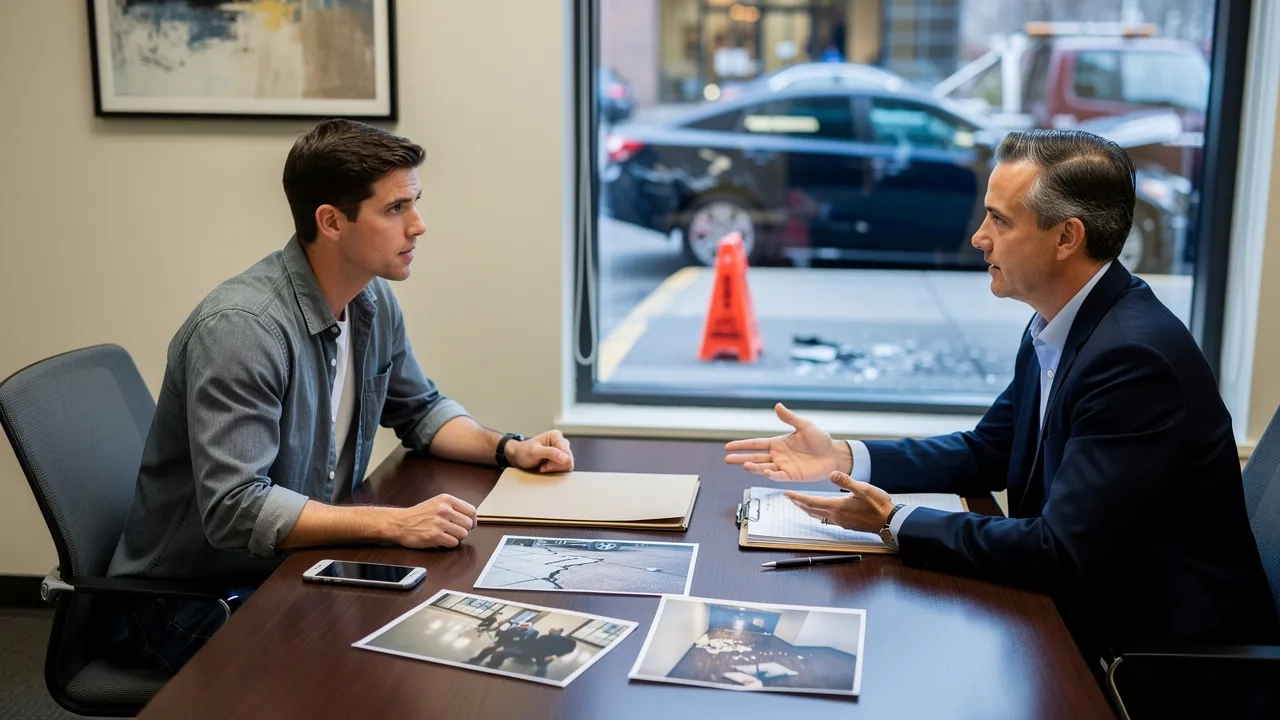
Start with the three questions a premises review must keep separate
A New York property injury should be reviewed through three separate questions, not one automatic conclusion. First, what dangerous condition or property-related event was involved? Second, what might the property owner or another responsible party have known about that condition? Third, can the available facts and records ultimately establish a legal claim? Keeping those questions apart helps you describe what happened without deciding liability before the relevant facts are assembled.
New York premises law may require property to be maintained in a reasonably safe condition and, in some circumstances, may require warnings about dangerous conditions. A cited New York court decision also explains that an open-and-obvious condition does not automatically eliminate the general duty of reasonable care, although the condition’s legal effect can depend on the circumstances. Those rules do not answer your individual case by themselves. They show why the condition, notice, and proof questions should be examined separately.
Use this guide to create a focused account of your incident before you speak with a lawyer. The useful starting point is not a prediction about whether you will recover money. It is a record that identifies the property, the condition, the sequence of events, the injury, the people who may have information, and the communications or documents connected to what happened.
Identify the property-related incident and condition
The incident may involve a slip, trip, or fall; a ceiling collapse; or an injury caused by fire. Bergman, Bergman, Fields & Lamonsoff, LLP identifies those incidents as premises liability case types, and we handle premises liability cases along with automobile accidents, construction accidents, products liability, and medical malpractice.
Describe the incident in concrete terms before you try to describe its legal meaning. Write down the location, the date and approximate time if known, what you were doing, what you noticed immediately before the event, what happened during the event, and what you observed afterward. Then separate the condition from the injury. For example, record whether the event involved a visible surface problem, falling material, smoke or fire, or another property-related circumstance, and separately record the physical symptoms and treatment that followed.
A short incident description can cover these points:
- The property address or a precise description of the location.
- The room, walkway, entrance, stairway, or other area where the event occurred.
- The condition you saw or encountered, using observations rather than conclusions.
- The people present, including anyone who saw the event or the condition.
- The immediate report, communication, or response after the incident.
- The injury symptoms, treatment, bills, and records connected to the event.
This account gives you a stable factual starting point. It does not decide who was responsible.
Ask what the property owner or other responsible party may have known
The notice question asks what the property owner or another responsible party may have known, or what the circumstances may show about notice, before the injury. In a cited New York construction case, the court discussed whether an owner had actual or constructive notice of the dangerous condition, even though the owner did not supervise the injured person’s work. That decision illustrates why ownership, control, inspection, prior complaints, and the condition’s history can be separate factual questions.
You may not know the full notice history yourself. Preserve the information you do have instead of filling the gaps with assumptions. Useful material may include the name or contact information for the owner, landlord, property manager, employer, tenant, or other organization involved; messages about the condition; reports made before or after the incident; and available property or lease documents. Witnesses may have seen the condition earlier, observed repairs, or heard a complaint that you did not hear. To make that information usable, build a simple notice timeline with four labels: when the condition was first observed, when it was reported or discussed, when anyone inspected or attempted to correct it, and when the injury occurred. Use only dates or approximate times you can identify, and mark gaps as unknown. Then attach each message, report, photograph, or witness name to the point it may illuminate. The purpose is not to turn a repair, complaint, or photograph into proof of notice. It is to show which parts of the history are documented, which come from a witness, and which still need investigation. This is particularly useful when the person who controlled the area is not the person who received your report, because it keeps control, communication, and timing from being treated as the same fact.
When you organize the notice issue, ask yourself:
- Who appeared to control the area where the incident occurred?
- Had you or someone with you seen the condition before the injury?
- Did anyone report it, discuss it, photograph it, or attempt to correct it?
- Did the condition change after the event?
- Which documents or people could help establish the timing?
These questions identify information for a legal review. They do not establish that any particular party had notice, and they do not identify the proper defendant.
Do not treat an obvious condition as an automatic answer
An open-and-obvious condition does not automatically eliminate the general duty of reasonable care under the cited New York court decision, but its legal effect can depend on the circumstances. A condition that was visible to you may still require a closer review of how it appeared, where it was located, what warnings existed, and how the surrounding facts affected the event. Visibility alone is not a complete answer.
Record the surrounding facts without labeling the condition as obvious, hidden, dangerous, or harmless. Note what you could see from your approach, whether anything blocked your view, what signs or warnings were present, how the area was arranged, and whether lighting or other conditions affected what you observed. Use only details you personally know or that a witness can identify. The legal significance of those details requires a fact-specific review. Visible condition and notice are related but not interchangeable. A condition may be visible at the moment of an incident without answering how long it existed, who controlled it, whether warnings were provided, or whether the surrounding layout affected what a person could see. Conversely, your not having noticed it earlier does not establish that no one else knew about it. This is why your notes should preserve both the view from your approach and the history you can identify. For each photograph or witness account, note whether it addresses appearance, warnings, timing, or control. That comparison gives a reviewer a clearer way to examine an open-and-obvious issue without treating any single observation as the legal conclusion.
The practical boundary is simple: do not abandon the record because the condition looked noticeable, and do not assume that a noticeable condition proves liability. Preserve photographs, communications, and witness information when available, then let the condition and notice questions be assessed together.
Build an incident record before the condition changes
A premises incident record should preserve what you know about the condition, the event, the injury, and the people who may have information. Photographs taken soon after an incident can document the hazard before the condition changes. Bergman, Bergman, Fields & Lamonsoff, LLP emphasizes the importance of early investigation in premises cases, so organize what is available while the details and documents are easier to trace.
Create a folder or written file with these items:
- Photographs or videos of the condition and the surrounding area, taken when it is safe.
- The date, time, location, and your own chronological account of the event.
- Names and contact information for witnesses, along with what each person observed.
- Property or lease documents that you already have access to.
- Police reports or other incident reports, if one was made.
- Medical records, bills, treatment notes, and records of follow-up care.
- Emails, texts, letters, or other communications with the owner, landlord, manager, insurer, or another involved party.
Keep original files where possible and note when each photograph, message, or report was created. A clear file makes it easier to distinguish what you saw from what someone later told you. After collecting materials, sort them by the question they may help answer rather than by file type alone. A photograph may show the condition or surrounding layout; a message may show when a report was made; a witness contact may identify someone who can speak to appearance or timing; a medical record may document treatment after the incident. The same item may bear on more than one question, and some questions may have no document yet. Add a short note identifying what each item actually shows and whether it is firsthand, received from another person, or created by an organization. Do not write that an item proves ownership, notice, negligence, or liability unless a lawyer later makes that assessment. This sorting method helps reveal missing links without filling them with assumptions.
Do not place yourself in danger to obtain a photograph or document. If the condition is no longer present, record when you last saw it and what changed, rather than trying to recreate the scene. If another person has relevant records, write down who has them and how you learned that they exist. This preserves leads for a later review without turning an uncertain detail into a fact.
Apply the additional steps specific to a ceiling collapse
A ceiling collapse does not by itself establish liability; proving negligence remains a central issue in a ceiling-collapse lawsuit. Your immediate task is therefore to protect your health, preserve the available account, and document the condition safely rather than assume what the collapse proves.
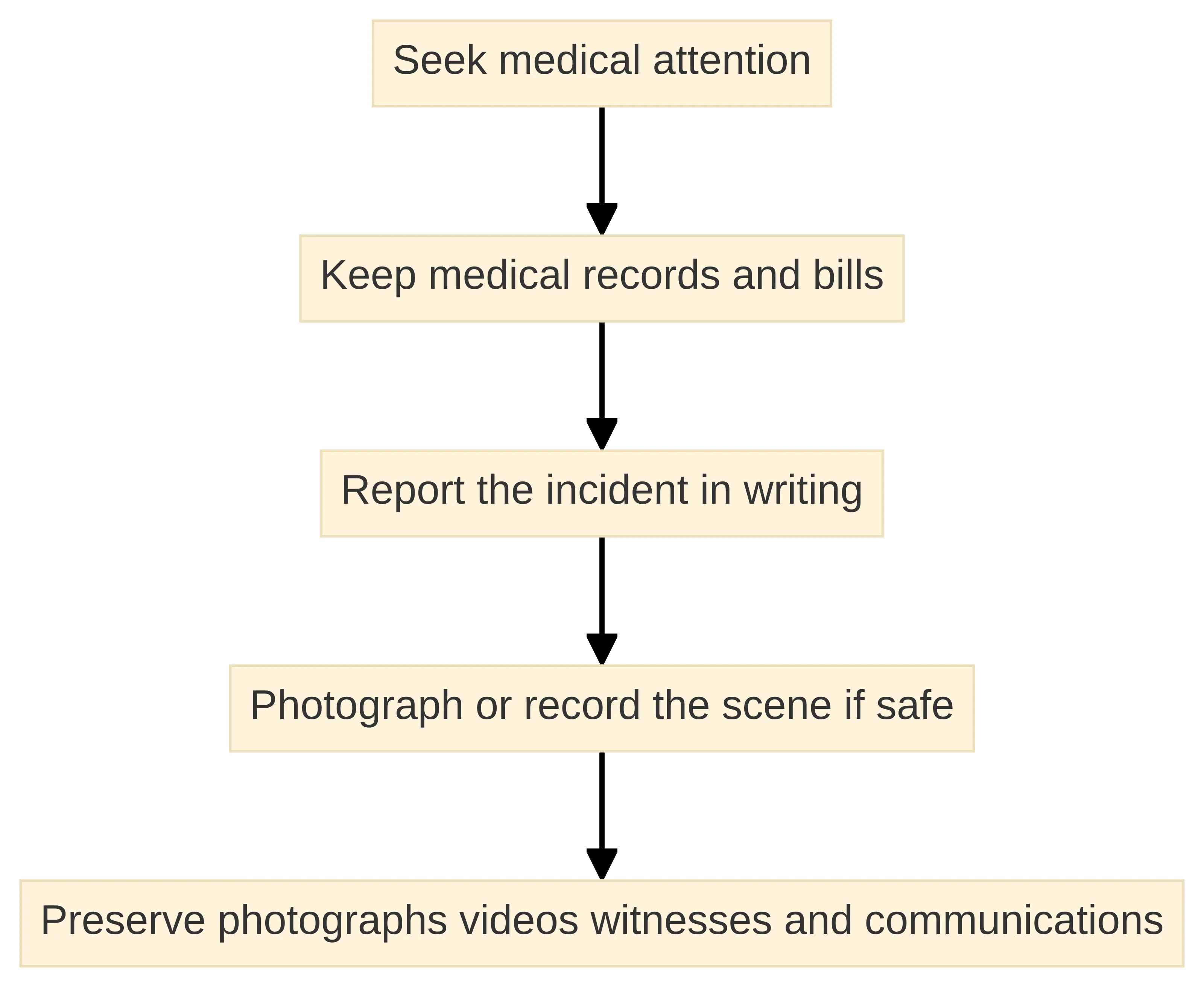
After a ceiling collapse, the supported sequence is:
- Seek medical attention for an injury and document the treatment you receive.
- Keep copies of medical records and related bills.
- Report the incident promptly in writing to the property owner, landlord, or manager.
- Photograph or record the collapsed ceiling and surrounding area if it is safe.
- Preserve photographs, videos, witness contact information, and communications with the owner or manager.
Use a written report that identifies the location, the event, the visible condition, and the date and time as accurately as you can. Keep a copy of what you sent and any response you received.
If you cannot safely return to the area, do not treat the absence of a photograph as the end of the record. Preserve witness information, messages, medical documentation, and any photographs or videos already taken. The same approach applies when repairs have begun: record what you know about the original condition and preserve communications about the work without guessing what the repairs mean legally. For this type of event, compare the condition record with the notice record rather than treating the collapse itself as the complete explanation. Note what part of the ceiling failed, what was visible before or after the event if known, who was told, and what response or repair you observed. If you do not know one of those facts, label it unknown. That label is useful because it identifies the question to raise in a consultation and prevents a gap in the record from becoming an unsupported conclusion. A written report should preserve your observations and the timing of your communication; it should not speculate about the cause of the collapse or identify a legally responsible party. The cited guidance supports medical care, written reporting, safe documentation, and preservation of related records; it does not establish that completing those steps proves negligence.
Focus a premises liability consultation on the condition record
For a ceiling collapse, focus the initial review on what the scene showed, when the condition was reported, and which people or records may preserve that account. It may also be useful when the condition changed, the incident involved a ceiling collapse or fire, witnesses have relevant information, or the records are spread across several people and organizations. These circumstances call for review; they do not establish that your claim will succeed. Use the consultation decision as a choice about what needs review first. If the condition is no longer available or the scene has changed, bring the earliest account and any safe documentation. If you do not know who controlled the area or when it was reported, bring the names, messages, and timeline that show the gap. If the condition was visible or warnings were present, bring the approach view and surrounding facts rather than assuming the issue is settled. This lets the discussion focus on a defined uncertainty—condition, notice, or the effect of visibility—rather than on a general request to determine whether the claim is valid.
Before the conversation, prepare a one-page summary with:
- What happened and where.
- What condition you encountered.
- When you first noticed it and whether it changed afterward.
- Who owned, occupied, managed, or controlled the area, as far as you know.
- What reports or communications were made.
- Who witnessed the event or condition.
- What treatment and related expenses followed.
- Which photographs, videos, reports, property documents, and messages you have.
Bring the underlying files as well as the summary. A concise overview helps you explain the event, while the original records let the discussion stay tied to what can actually be examined.
At Bergman, Bergman, Fields & Lamonsoff, LLP, we handle premises liability cases, including slip-and-trip-and-fall accidents, ceiling collapses, and injuries caused by fire. We emphasize early investigation in premises cases. We have full-service offices in Hicksville, Nassau County, and Kew Gardens, Queens, so you can choose the office that is practical for your New York property-injury discussion.
Know what a premises liability consultation can and cannot resolve
A focused consultation can help organize the unresolved questions around the condition, possible notice, the identity or role of the property parties, and the documents that may bear on those questions. It can also give you a place to explain the injury and treatment record in sequence. In New York, the cited decisions show that the effect of an obvious condition and the significance of actual or constructive notice can depend on the circumstances, so those issues should be discussed with the incident record in front of you.
A consultation cannot, from a short description alone, determine that you have a valid claim, identify a liable party, calculate damages, establish a deadline, or guarantee a recovery. A ceiling collapse, a visible condition, an injury, or an available photograph is not a substitute for the full legal and factual review. Keep those limits in mind when you organize your questions.
Take questions that connect directly to your record, such as:
- What facts about the condition still need to be established?
- Which person or organization may hold the missing documents?
- What should you preserve while the property condition changes?
- How should you organize medical, witness, and communication records?
- Which parts of the incident require a separate review under New York law?
Those questions keep the discussion practical. They also help separate facts you can document now from legal issues that require individual assessment.
Use a ceiling-collapse response sequence before the consultation
After a ceiling collapse, prioritize medical attention, document treatment and medical records, report the incident promptly in writing to the owner, landlord, or manager, and photograph or record the scene if it is safe. Then bring that record to Bergman, Bergman, Fields & Lamonsoff, LLP for a focused discussion of the New York property injury. We offer premises liability representation and emphasize early investigation, including review of the facts and documentation available after the incident.
Only a qualified New York attorney can assess how the law applies to your individual facts. You do not need to predict the result before seeking that assessment; you need a clear account of what happened and the records that support it. Use the organized file as your starting point for the next conversation.
What information should I bring to a premises liability consultation?
When is it appropriate to contact a premises liability attorney?
Contact a premises liability attorney if you have sustained an injury related to a property condition and have questions about the incident, the property owner’s knowledge of the condition, or if you need assistance in gathering evidence and understanding your legal options.
What is the importance of early investigation in premises liability cases?
Early investigation is crucial in premises liability cases because it helps preserve evidence while conditions are still fresh.
What should I bring to a consultation with a premises liability attorney?
When meeting with a premises liability attorney, bring a summary of the incident, photographs, medical records, witness information, and any communications with the property owner. This organized information will help the attorney assess your case effectively.
What are the potential outcomes of a premises liability consultation?
A premises liability consultation can help clarify unresolved questions about the incident, the property owner’s knowledge of the dangerous condition, and the evidence needed to support your claim. However, it cannot guarantee a specific outcome or determine liability without a full legal review.
Keep reading
More on Slip & Fall
 Slip & Fall
Maximize Your Case: Best Practices with Premise Liability Lawyers
Discover best practices for working with premise liability lawyers to strengthen your case.
Read article Slip & Fall
Maximize Your Average Settlement for Slip and Fall Knee Injury
Discover the average settlement for slip and fall knee injury and factors influencing compensation.
Read article Slip & Fall
4 Best Practices for Hiring Lawyers in Slip and Fall Cases
Discover essential best practices for hiring lawyers in slip and fall cases to secure your compensation.
Read articleHurt like this?
Tell us what happened.
We handle Slip & Fall cases across Long Island, Queens and New York City. The consultation is free and you pay nothing unless we win.
- Answered 24/7
- No fee unless we win
- Hablamos español
Send us the details
Takes about a minute. Free and confidential.