Construction Accidents
Negligence Definition: What Construction Workers in New York Should Know
Begin with what negligence means
In an injury setting, the issue is not simply whether something went wrong; the issue is whether the available facts support examining the conduct, the applicable duty, and the connection to harm or injury to you. Negligence is a civil wrong that can impose legal liability on a defendant.
An act or an omission can support a negligence analysis. An act might involve using equipment carelessly or creating a dangerous condition. An omission might involve failing to take a safety step, but an omission matters only when the party had a duty to act. The duty, the conduct, the connection to your injury, and the available proof all matter together.
For a construction worker, that definition creates a useful starting point without deciding your claim. A fall, struck-by incident, scaffold problem, trench event, or equipment malfunction may raise questions about reasonable care. The event itself does not answer those questions. You need to examine what safety responsibility existed, what happened, how the event caused harm, and what records support each part.
Use reasonable care as the starting lens
Reasonable care is evaluated in light of the circumstances, including the foreseeable likelihood and severity of harm and the burden of precautions that could eliminate or reduce the risk. Those factors do not turn every unsafe result into negligence. They help frame the question you need to ask: what level of care was reasonably called for before the incident occurred?
The foreseeable likelihood asks whether the risk could reasonably be anticipated. On a construction site, that question may involve the work being performed, the equipment in use, the height or location of the task, and the conditions surrounding it. The foreseeable severity asks what could happen if the risk materialized. A fall from an elevated surface, a scaffold collapse, or a malfunctioning machine may present different possible consequences than a minor housekeeping issue.
The burden of precautions asks what measures could have reduced the risk and what was required to put them in place. A practical safety step may include maintaining equipment, inspecting it, controlling an area, or following an applicable safety practice. You should treat these as questions for a factual review, not as conclusions that a particular contractor, owner, employer, or coworker was negligent.
Map the Incident to People, Conduct, and Records
For a New York construction incident, start with an evidence-to-party map rather than treating the accident, an unsafe condition, or a rule issue as the answer.
First, make a short event record. Accurately note what happened and how you were hurt, then obtain qualified medical care. Follow the treatment plan provided by qualified medical professionals, attend follow-up appointments, take prescribed restrictions seriously, and describe your symptoms and how the injury occurred accurately. Medical records often help show the full impact of a workplace injury.
Next, connect each important fact to the people and companies involved. Project and company records may help identify who supplied equipment, directed the task, controlled the area, or had notice of a condition. Employment relationships and site roles help determine which records matter. Available material may include photographs, surveillance footage, equipment data, maintenance records, safety documents, witness information, physical evidence, and electronically stored information.
Then compare the described conduct with reasonable care. Consider the foreseeable likelihood and severity of harm and the burden of precautions needed to reduce the risk. In a construction-accident context, a breach can involve failing to follow safety standards, regulations, or basic precautions; examples include failing to maintain scaffolding or regularly inspect safety equipment. These possibilities do not establish liability on their own.
Finally, use the map to identify what remains unanswered: whether the conduct was connected to the injury, what records support each account, and which legal path may apply. OSHA materials may inform an investigation, but a regulatory issue does not automatically decide civil liability. A workers’ compensation claim is different from a claim against another contractor, property owner, driver, maintenance company, or product manufacturer. A qualified New York attorney should assess the specific facts, evidence, possible claims, and applicable law.

Translate the framework to construction-site conduct
Construction-site conduct can raise breach questions when a party may have failed to follow safety standards, regulations, or basic precautions. The examples are starting points for investigation, not findings of liability.
Possible questions include:
- Was proper scaffolding maintained for the work being performed?
- Was safety equipment regularly inspected before use?
- Were workers exposed to a fall, collapse, or equipment risk that could have been addressed through a precaution?
- Did a contractor or another responsible party control the relevant task, equipment, or area?
A contractor’s failure to maintain proper scaffolding or regularly inspect safety equipment can be considered a breach of duty. In many construction accidents, including scaffolding collapses, falls from heights, and equipment malfunctions, a breach may be a significant contributing factor. You still need to connect the suspected failure to your accident and injury. A damaged scaffold, missing precaution, or malfunctioning machine may point to an important question, but it does not by itself establish who was legally responsible.

Separate an incident from provable negligence
An accident is an event; negligence is a legal theory that requires a supported connection between unreasonable conduct and harm. An unsafe condition may deserve attention without proving who created it, who controlled it, who knew about it, or whether it caused your injury. A safety or regulatory violation may be relevant without automatically deciding civil liability.
The same boundary applies to an incident report, a workplace label, or a statement that something was against company policy. Each item may help establish what happened, yet you still need to examine duty, breach, causation, harm, and the parties involved.
Do not treat the following as interchangeable:
- Accident: something unexpected happened.
- Unsafe condition: a condition may have created a risk.
- Rule violation: a safety, regulatory, or workplace requirement may not have been followed.
- Provable negligence: the available facts support the required legal connection between a duty, unreasonable conduct, causation, and harm.
That distinction protects you from two opposite mistakes: dismissing a serious incident because it was called an accident, or assuming that an unsafe condition automatically proves a negligence claim.
Build the first factual record safely
Your health comes first after a suspected injury-related incident. When your injury requires medical attention, obtain qualified medical care and accurately explain your symptoms and how the incident occurred. Follow the treatment plan provided by qualified medical professionals, attend follow-up appointments, and take prescribed restrictions seriously.
Preserve the available incident record without worsening your condition or interfering with medical instructions. Useful material may include:
- photographs of the area, equipment, visible conditions, and your injuries;
- surveillance footage, equipment data, maintenance records, and safety documents;
- physical evidence that remains available;
- names and contact information for witnesses; and
- electronically stored information related to the incident.
Do not guess about symptoms or add details you cannot support. Accurate descriptions of what you felt, what you saw, what task you were performing, and what happened afterward are more useful than a confident but incomplete account.
Act without waiting when the injury requires medical care or when photographs, footage, equipment, records, or witness information may become unavailable. Seek medical attention first when needed, then preserve what you can safely preserve.
Use site roles and records to clarify the issue
Available records can help organize the task, equipment, and area involved. The company that employed you may not be the only party connected to the worksite or the event.
Relevant records may include contracts, subcontract agreements, daily reports, job hazard analyses, toolbox talks, inspection records, training records, equipment manuals, maintenance logs, lift plans, permits, schedules, delivery records, change orders, incident reports, and communications. You do not need to decide the legal meaning of every record before preserving it.
Employment relationships and site roles help determine which records matter when evaluating a construction incident. A clear timeline can add structure without turning the record into a legal conclusion. It can identify the task underway, the equipment or condition involved, the location, the people and companies present, any warning or instruction you personally received, the event itself, immediate symptoms, treatment, and later follow-up. Keep personal observations distinct from information supplied by someone else, and note where the account comes from. If descriptions differ, record the difference rather than smoothing it over. The purpose is to preserve an accurate account for later review while leaving the legal conclusion open.
Organizing records by the role they may help clarify can make the collection more useful. Contracts and subcontract agreements may help show relationships among companies. Daily reports, schedules, delivery records, and change orders may place the task or equipment in the project record. Job hazard analyses, toolbox talks, training records, permits, and lift plans may show what planning and safety materials existed. Inspection records, equipment manuals, and maintenance logs may focus questions about the equipment. Incident reports and communications may preserve accounts of what was reported after the event. These categories do not, by themselves, establish a duty, a breach, causation, or legal responsibility; they help show what is documented, what is disputed, and what may need further review.
Dates can also separate what existed before the event from what was recorded afterward. That sequence can place planning materials, incident accounts, medical records, and follow-up information in context without treating the order of a document as proof of negligence.
When several companies or parties were involved, list each role without assuming that employment, ownership, control, or equipment supply resolves the negligence question. Compare the timeline with the available records and medical information, while keeping the description of symptoms accurate. A qualified New York attorney can assess the organized material in light of the specific facts, possible claims, and applicable law.

Keep compensation routes distinct from the negligence question
The fact that an injury happened at work does not identify every possible legal path or every potentially responsible party.
Start by separating the questions:
- What happened to you, and what medical care followed?
- Which company employed you, and which companies or parties were present?
- Who supplied the equipment, directed the task, controlled the area, or may have known about a dangerous condition?
- What records connect each party to the work and the incident?
This separation does not determine whether you have a claim. It prevents you from assuming that the workplace setting alone resolves the negligence question. Employment relationships and site roles help determine which records matter, while the facts and applicable law determine how those records may be used.
Recognize when the facts need qualified review
Shared responsibility, disputed causation, and unclear site roles are signals that the incident needs case-specific legal review. Comparative negligence assigns fault when multiple parties share responsibility for an accident. That principle means your own conduct may become part of the analysis without automatically answering whether another party also acted negligently.
New York case law can also distinguish between a defendant’s alleged negligence and a plaintiff’s alleged comparative negligence. A court may determine a defendant’s negligence while leaving the plaintiff’s comparative negligence for later consideration. In a different posture, a plaintiff may not obtain partial summary judgment when facts could allow a jury to find that the plaintiff’s conduct was the sole proximate cause of the injury. These are court-specific conclusions, not a formula you can apply to your incident without examining the record.
Causation can require careful attention even when the exact degree of an outcome cannot be measured. Your medical records, incident account, photographs, witness information, site records, and equipment information can help organize that question, but they do not replace an evaluation of the particular facts. Medical records may document the injury and symptoms without identifying which party owed a duty or whether a site condition caused the event; those questions require the incident and project evidence as well.
Bring the organized record forward when you cannot identify the responsible party, when multiple companies had different roles, when another party blames your conduct, or when the available facts do not clearly connect a suspected failure to your injury.
Request the next step with your record ready
Your next step is easier to discuss when your account is organized. Gather the incident date and location, the task you were performing, the equipment or condition involved, the companies and site roles you can identify, your medical information, photographs, witness details, and available safety or project records. Keep the account accurate and separate what you personally observed from what someone else told you.
A qualified New York attorney should assess your specific facts, evidence, possible claims, comparative-fault issues, and applicable New York law, including any deadlines that may affect your options. If your injury requires medical care or evidence may disappear, act on those immediate needs first.
We operate 24 hours a day, 7 days a week, so you can raise an urgent question about the incident and the records you have available.
Questions about negligence after a New York construction incident
How many elements are used to describe negligence?
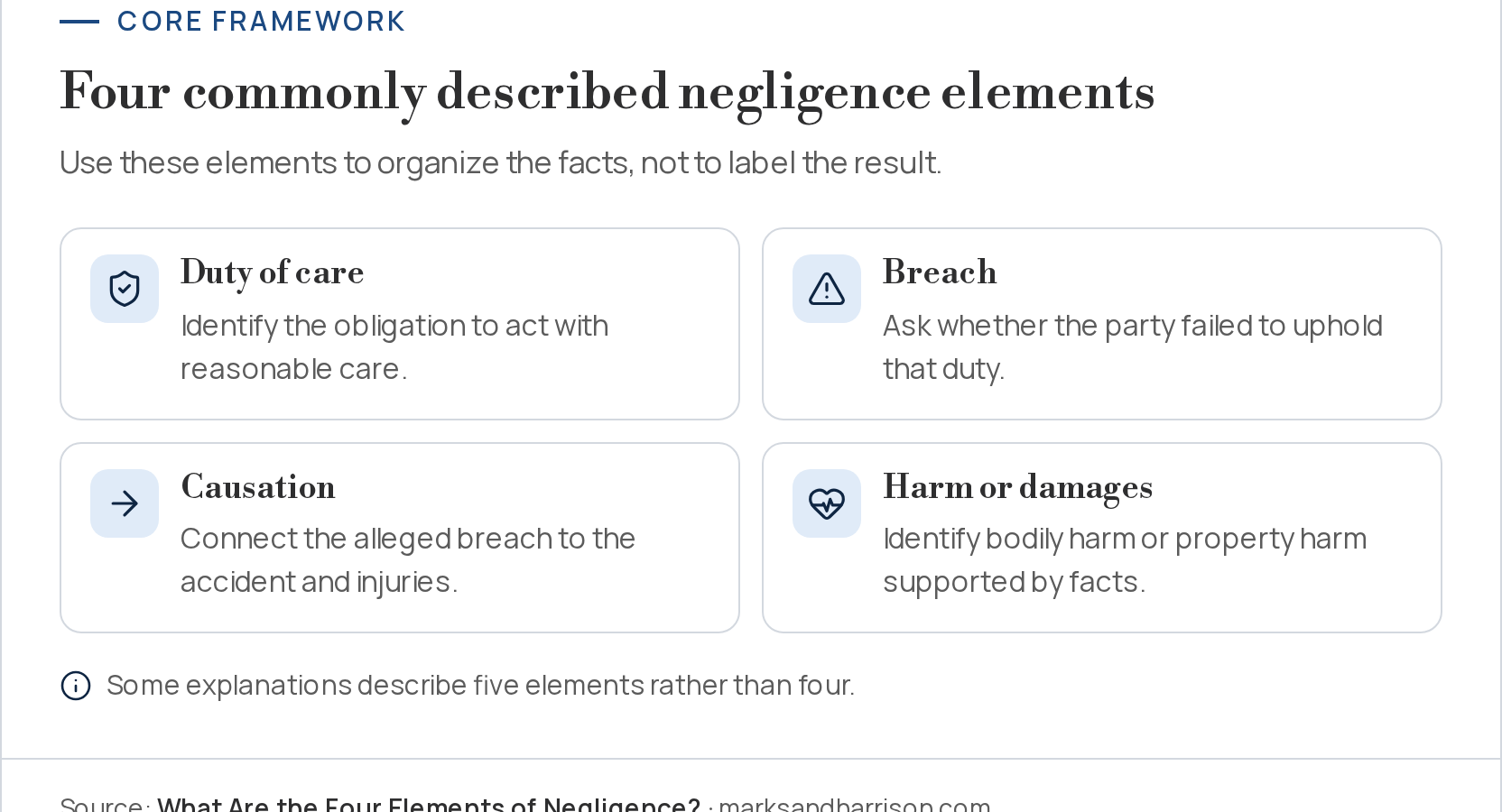
Legal explanations may use four or five elements, depending on how the requirements are grouped. The commonly discussed concepts are duty, breach, causation, and harm or damages. This is a general framework, not a guaranteed test for every New York claim.
Can a construction-site safety violation prove negligence by itself?
No. A safety or regulatory violation may be important evidence, but it does not automatically establish civil liability. The facts must still address who had a duty, what conduct breached that duty, whether it caused the injury, and what harm occurred.
What evidence should I preserve after a suspected construction injury?
When it is safe to do so, preserve photographs, witness information, incident communications, surveillance or equipment data, maintenance and safety records, and relevant project documents. Keep materials in their original form, do not alter or discard evidence, and follow qualified medical professionals’ instructions first.
When should I act urgently after a construction incident?
Act promptly when the injury requires medical care or when photographs, footage, equipment, records, or witness information may disappear. Obtain qualified medical attention, accurately describe what happened and your symptoms, follow prescribed restrictions, and preserve available information without worsening your condition.
Keep reading
More on Construction Accidents
 Construction Accidents
How to Choose an Injury Attorney in Westchester County After a Construction Accident
Compare a Westchester County injury attorney after a construction accident, protect evidence, and understand workers’ comp and contingency fees.
Read article Construction Accidents
Personal Injury Settlement Amount Examples for New York Construction Accidents
Compare New York construction injury settlements and verdicts, and learn which facts can shape your claim, evidence, and timeline.
Read article Construction Accidents
Best Personal Injury Lawyer NYC for a Construction Injury: How to Compare Your Options
Compare New York construction-injury lawyers by experience, claim routes, deadlines, communication, fees, and consultation fit.
Read articleHurt like this?
Tell us what happened.
We handle Construction Accidents cases across Long Island, Queens and New York City. The consultation is free and you pay nothing unless we win.
- Answered 24/7
- No fee unless we win
- Hablamos español
Send us the details
Takes about a minute. Free and confidential.