Construction Accidents
Should New York Construction Workers Contact Bergman, Bergman, Fields & Lamonsoff, LLP?
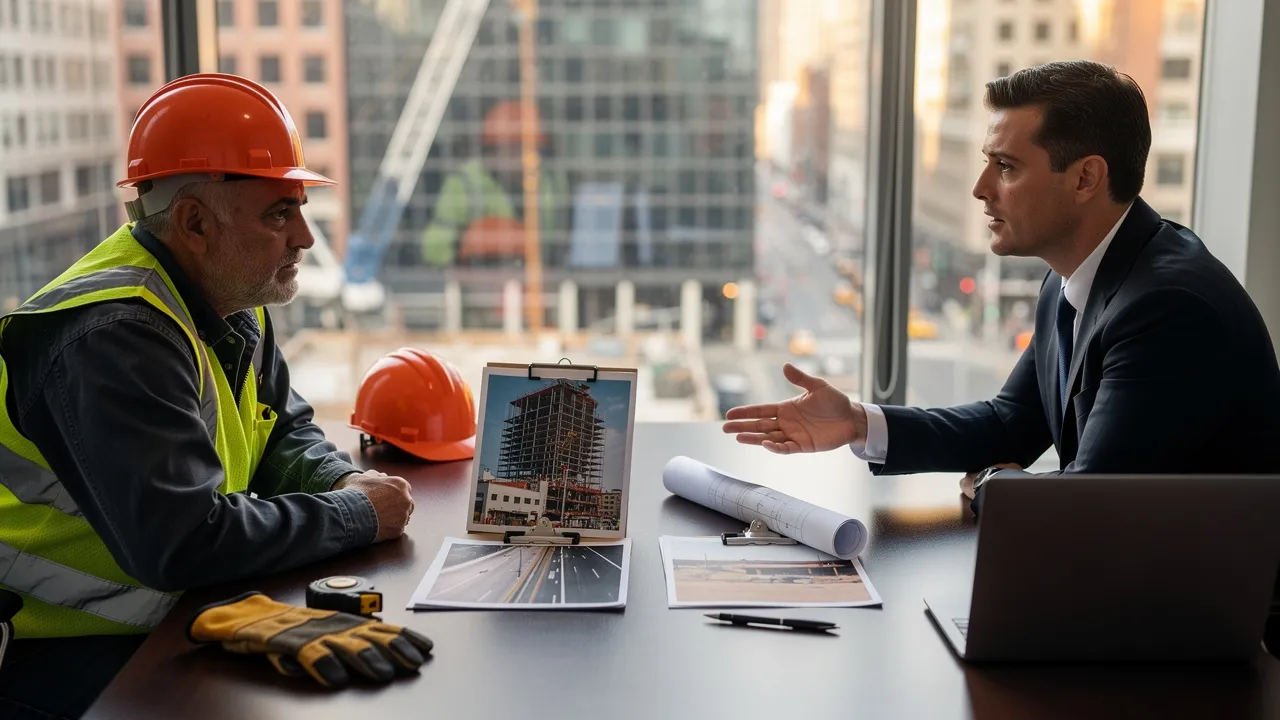
Is this New York firm relevant to your search?
A search that starts with Las Vegas points to a different jurisdiction from the New York setting addressed here. Bergman, Bergman, Fields & Lamonsoff, LLP has offices in Hicksville, Nassau County, and Forest Hills, Queens. We handle construction-accident cases and offer free consultations for personal-injury cases.
That location distinction should come before any discussion of legal fit. If your injury occurred in New York or your work connects you to the Hicksville or Forest Hills area, our stated New York practice may be relevant to a first conversation. If your situation is in Nevada, the New York information on this page should not be treated as a basis for assuming that we are a local Nevada resource.
The decision is therefore narrower than choosing a lawyer from a search result. First, match the location. Next, compare what happened with the construction and personal-injury matters we identify. Then decide whether you are ready to have a consultation with a short, organized account of the incident. A practice-area match can justify contact, but it does not determine your eligibility, deadlines, potential recovery, or likely result.
This guide is designed for construction workers and families connected to Hicksville, Nassau County, Forest Hills, Queens, and other New York locations who want to understand whether our stated practice is relevant. The useful question is not whether a general search phrase led you here. It is whether your circumstances have a New York connection and whether the subject of your injury falls within an area we identify.
Begin with the Hicksville and New York service connection
The Hicksville office is a practical starting point if you work in or near Hicksville and can use that New York connection for an initial conversation. Bergman, Bergman, Fields & Lamonsoff, LLP has an office in Hicksville, Nassau County, and another in Forest Hills, Queens. For construction-accident cases, we offer 100% free consultations.
Use the location as a fit question, not as a conclusion about your matter. Ask yourself:
- Is Hicksville, Nassau County, a practical location for you or your family?
- Is the incident connected to construction work or another personal-injury category identified in our practice information?
- Can you give a clear account of what happened and how the injury affected daily life?
A focused first contact makes sense when the Hicksville location is practical, the stated practice includes construction accidents or a related part of the incident, and you are ready to explain what happened and how it affected daily life. Those conditions help you decide whether to begin a conversation; they do not establish that you have a valid claim or that any particular legal protection applies.
Forest Hills, Queens, is another office location identified for our practice. That gives you a second New York location to keep in mind when considering how an initial conversation could take place. The key point is consistency: this is a New York-focused choice, not a Las Vegas or Nevada selection.
If the location and subject matter fit, move to the next question: does the incident resemble a matter we identify as part of our practice? You do not need to decide the legal category before speaking with an attorney. You do need to describe the place, work connection, event, and injury clearly enough for the conversation to begin.

Compare your incident with the stated practice areas
The stated practice areas include construction accidents and several other personal-injury categories. We handle construction-accident cases, and we handle motor vehicle accidents involving two cars, pedestrians, bicyclists, motorcycles, or motor homes. Michael E. Bergman, Esq., focuses on motor vehicle negligence, construction accidents, slip/trip and fall, wrongful death, medical malpractice, and product liability.
Compare your event with those descriptions without trying to label the legal claim yourself. A construction injury might involve a job-site event, while a vehicle incident might involve a worker, a driver, a pedestrian, a bicyclist, or a motorcyclist. The description of the event matters because the same broad word—“accident”—can cover different circumstances and different people involved.
A simple comparison can help you organize the first conversation:
- Construction accident: Identify the connection between the injury and construction work, including the setting in which the event occurred.
- Motor vehicle accident: Identify whether the event involved two cars, a pedestrian, a bicyclist, a motorcycle, or a motor home.
- Slip or trip and fall: Describe the event in plain language rather than assuming which legal category applies.
- Other identified areas: Medical malpractice, product liability, and wrongful death are also named in the practice information.
This list is a way to decide whether the subject of your incident appears related to an area we identify. It is not a finding that your facts fit a particular claim. The practice description also names motor vehicle negligence, which is a narrower description than every possible vehicle-related problem.
Keep your account factual: explain what happened, where the injury occurred, who was involved, and what changed afterward. If you are unsure whether an incident belongs under construction, motor vehicle, premises, product, or another category, preserve the facts instead of forcing them into a label. The consultation can then address how those facts relate to the practice areas.
Account for complications in construction-related vehicle incidents
A construction worker involved in a vehicle accident while on the job may face a more complicated responsibility question than the event description alone suggests. When a construction worker is involved in a vehicle accident while on the job, determining whether an employer or another party is liable can be complex.
That general point matters when you prepare your account. Do not reduce the incident to a single sentence such as “I was hit at work” or “I was in a construction vehicle accident.” Explain the work connection and the vehicle event separately so the attorney can understand the setting. A useful account can identify:
- What construction-related activity was taking place when the vehicle incident occurred.
- Whether you were inside a vehicle, operating one, walking near traffic, or affected in another way.
- What happened during the event and what injury or symptoms followed.
- How the injury affected your daily life after the event.
These prompts organize the facts; they do not answer who may be legally responsible. The employer-versus-another-party question requires attention to your individual circumstances. Treat the vehicle connection as a reason to explain more, not as a reason to assume that one person or organization is responsible.
A construction-related vehicle incident can also overlap with the motor vehicle categories we identify, including accidents involving cars, pedestrians, bicyclists, motorcycles, or motor homes. Describe the overlap plainly. For example, explain whether you were performing construction work, traveling for work, operating equipment, standing near a roadway, or involved in another setting only if that is what happened. Then take that account into a consultation rather than reaching a liability conclusion before the facts have been reviewed.
This distinction is especially useful when your family is helping you prepare. A family member may know the effect of the injury on daily life but not the details of the job site or vehicle event. Combine those perspectives without changing the underlying account. Separate what you personally observed from what someone else told you.
What the free consultation is described to cover
The construction-accident consultation is described as a conversation in which our experienced construction accident attorneys gather information about injuries and job sites. We offer 100% free consultations for construction accident cases. We also offer free consultations for personal-injury cases.
That description gives you a practical way to prepare for the conversation. The purpose of your first contact is to explain the event and its effect, then ask how the matter would be approached. Sharing relevant details about the accident, injuries, and communications with insurance companies can help an attorney evaluate the case and provide customized guidance.
Before the consultation, write down the questions you want answered. Three topics to discuss are:
- Experience with situations similar to yours.
- How the matter would be managed.
- The pricing structure.
These questions are different from asking whether you will win. They help you understand what the conversation covers and what information the attorney needs from you. You can also ask whether the construction setting, vehicle involvement, or another practice area should be the main focus of the discussion.
A useful first conversation has two parts. Your part is to give a clear account of the event, injuries, daily effects, and relevant insurance communications. The attorney’s part is to respond to your questions about experience, management, and pricing structure. Keeping those parts distinct can make the discussion easier to follow.
If you are speaking on behalf of an injured family member, say that at the beginning and explain which facts you know directly. If the injured worker is able to participate, make space for the worker’s own description of symptoms and daily effects. The consultation can then begin with a clearer account rather than a collection of disconnected details.
Keep your description direct. If you are unsure about a detail, identify it as uncertain instead of filling the gap with an assumption.
Prepare the incident details before making contact
A short incident account gives you a clear starting point for a consultation. Prepare a concise description of what happened, your symptoms, and how the injury affected daily life. The New York State Workers’ Compensation Board glossary describes an accident description as text about what happened, often organized in response to a series of questions.
You can use that question-and-answer approach to arrange your notes:
- What happened? Describe the event in sequence and identify its connection to construction work or a vehicle incident.
- What injuries or symptoms followed? Use the words that describe your physical condition and the changes you noticed.
- How did daily life change? Explain the effect on ordinary activities in concrete terms.
- What insurance communications occurred? Share relevant communications with insurance companies during the consultation.
The first item should stay factual. You do not need to turn it into a legal argument. If the event involved a vehicle while you were working, state that connection clearly and identify the people or vehicles involved as you understand them. If the event occurred at a job site without a vehicle, explain the work setting and what happened there.
The second and third items show the difference between the event and its effect. A brief account should not stop at the moment of injury; it should also describe symptoms and the way the injury affected daily life. You might describe changes in movement, work activity, sleep, household tasks, or other ordinary activities only to the extent that they reflect what you experienced. Avoid turning those descriptions into a prediction about the legal significance of the injury.
The fourth item covers communications with insurance companies. Include the relevant substance rather than trying to predict what those communications mean legally. Sharing relevant details about the accident, injuries, and insurance communications can help an attorney evaluate the case and provide customized guidance.
A clear account can also distinguish known facts from questions. You might know where the event occurred but be uncertain about which company controlled a particular area. You might know that a vehicle was involved but not know who owned it. Record those uncertainties plainly. Do not fill them with guesses.
Keep the account short enough to explain aloud. You can expand on each point when questions arise. Preparation is a communication aid, not a determination of eligibility, a deadline, responsibility, or potential recovery.
Ask how communication and case management would work
The communication process is a reasonable subject to raise during your first conversation. Bergman, Bergman, Fields & Lamonsoff, LLP emphasizes personal and frequent one-on-one communication with our clients. Before a consultation, you can ask about experience with similar situations, how the matter would be managed, and the pricing structure.
Use those topics to make your questions specific to the situation you described. For example:
- How would communication about the matter be managed?
- What information should you be ready to provide after the initial conversation?
- How would questions about a construction site, a vehicle incident, injuries, or insurance communications fit into the discussion?
- What pricing structure would apply to the matter?
The point is to understand how the matter would be discussed and how you would communicate about it. Personal and frequent one-on-one communication describes our stated approach; it does not promise a particular schedule, result, or legal determination.
You can also ask how to direct future questions and what kind of updates you should expect to discuss. Keep those questions practical rather than assuming that a general answer applies to every matter. The conversation should address the facts you provide and the questions you raise.
Your organized incident account can make these questions easier to answer. Explain the event first, then describe your symptoms and its effect on daily life. After that, raise the questions you wrote down about experience, management, communication, and pricing. This keeps the conversation focused without requiring you to decide the legal meaning of every fact in advance.
If a family member is helping with communication, identify that person and explain how you want information shared. Keep the arrangement clear during the conversation. Frequent one-on-one communication is part of our stated approach, but the details of communication for a particular matter should be discussed directly.
Keep suitability and outcome questions for an individualized review
A practice-area match cannot determine whether your individual matter is suitable for representation or what it might produce. The descriptions of construction accidents, motor vehicle accidents, and related personal-injury areas help you decide whether a conversation is relevant, but they do not answer case-specific questions.
Keep four questions separate when you prepare:
- Relevance: Does the event appear related to a practice area we identify?
- Suitability: After reviewing your facts, is a consultation appropriate for your situation?
- Timing: What deadlines or timing issues may apply to your individual matter?
- Potential recovery: What, if anything, might be available based on the facts and applicable law?
This guide helps with the first question and with preparing for a conversation. The remaining questions require an individualized review. Do not treat a general description, a practice-area list, or a free consultation as a prediction of eligibility, responsibility, value, or result.
That separation also helps you decide what to ask. You can ask whether our stated practice includes the subject of the incident. You can explain the facts that may affect the discussion. You can ask which questions require further review. You should not treat a general description of our services as an answer about your specific matter.
The same boundary applies when your circumstances seem straightforward. A construction accident can involve different work settings, vehicles, property conditions, people, and communications. A motor vehicle incident can involve different participants and work connections. Describe those details and leave the case-specific conclusions for the individualized review.
Request the consultation with your organized account
A focused consultation is a reasonable next step when Hicksville is practical for you, our stated practice includes construction accidents or a related part of your incident, and you are ready to explain what happened and how it affected daily life.
Before you make contact, keep your account within reach and be ready to cover three points:
- What happened and how the incident connected to construction work or another identified practice area.
- What symptoms or injuries followed and how they affected daily life.
- What questions you want to ask about similar experience, management, communication, and pricing structure.
This approach lets you assess whether a conversation is relevant without treating this page as a decision about eligibility, deadlines, potential recovery, or outcome. A qualified New York attorney must review your individual facts to address those questions. If the New York location and subject matter fit your circumstances, bring the organized account and your prepared questions to that conversation.
What should you bring to a construction-accident consultation?
Is a Las Vegas personal injury lawyer appropriate for an injury connected to New York construction work?
Not based on the information supplied here. This page concerns Bergman, Bergman, Fields & Lamonsoff, LLP’s New York practice, with offices in Hicksville, Nassau County, and Forest Hills, Queens. If your situation is in Nevada, do not assume that New York information establishes local suitability. A New York connection and a stated practice-area match are the appropriate starting points for this firm.
Can a consultation determine whether I have a valid construction accident claim?
No general page can make that determination. A consultation allows an attorney to review your individual account, injuries, job-site details, and relevant communications. Suitability, eligibility, possible deadlines, responsibility, and potential recovery require an individualized review and should not be inferred from a practice-area description or a free consultation.
What should I ask about communication and pricing during the first conversation?
You can ask how the matter would be managed, how communication would work, what experience applies to similar situations, and what pricing structure would apply. Bergman, Bergman, Fields & Lamonsoff, LLP states that it emphasizes personal and frequent one-on-one communication, but the practical arrangements for a particular matter should be discussed directly.
What information can help an attorney review a construction-related injury?
Prepare a concise account of what happened, the construction or vehicle connection, your injuries or symptoms, how the event affected daily life, and relevant communications with insurance companies. Separate facts you know from details that remain uncertain. This preparation supports an informed conversation but does not establish liability, eligibility, a deadline, or a likely result.
Keep reading
More on Construction Accidents
 Construction Accidents
How to Choose an Injury Attorney in Westchester County After a Construction Accident
Compare a Westchester County injury attorney after a construction accident, protect evidence, and understand workers’ comp and contingency fees.
Read article Construction Accidents
Personal Injury Settlement Amount Examples for New York Construction Accidents
Compare New York construction injury settlements and verdicts, and learn which facts can shape your claim, evidence, and timeline.
Read article Construction Accidents
Best Personal Injury Lawyer NYC for a Construction Injury: How to Compare Your Options
Compare New York construction-injury lawyers by experience, claim routes, deadlines, communication, fees, and consultation fit.
Read articleHurt like this?
Tell us what happened.
We handle Construction Accidents cases across Long Island, Queens and New York City. The consultation is free and you pay nothing unless we win.
- Answered 24/7
- No fee unless we win
- Hablamos español
Send us the details
Takes about a minute. Free and confidential.