Medical Malpractice
How to Prepare for a New York Medical Malpractice Attorney Consultation

Start with the consultation decision, not a conclusion about negligence
A New York medical malpractice consultation can help you organize an account of what happened and identify questions that require closer review. You do not need to settle the legal meaning of your treatment before deciding whether to contact an attorney. Start with the facts you can place in time: the health professional or facility involved, the care you expected, what happened afterward, and the records or communications you already have.
A consultation-readiness check is different from a diagnosis of negligence. The same outcome can raise different questions depending on the treatment, the provider, the condition being treated, the sequence of events, and the available records. Your task before the first conversation is not to prove a case. Your task is to make the account understandable enough for focused questions.
Begin with four basic questions:
- What care or treatment concerns you?
- Which health professional, practice, hospital, or facility was involved?
- What changed after the care, and when did you notice it?
- What do you want an attorney to review or explain?
Write down the answers without filling gaps from memory. A short, accurate account is more useful than a long account that treats uncertain dates or explanations as settled facts.
We describe medical malpractice as negligence by a health professional that causes damage, and we represent people seeking legal help with suspected medical negligence. Those statements describe the type of matter we handle; they do not determine whether your circumstances meet a legal standard. If your concern involves care in New York, gather the basic record and request a consultation when the questions, timing, or consequences make outside review useful.
You can seek a consultation even when you are unsure whether the concern reflects negligence. Contact is a way to put the facts before counsel for review, not a declaration that your interpretation is correct. Keep that distinction in your notes and in the way you describe the matter.
What a medical malpractice attorney can review
A New York med mal attorney can review the account of the care, the people and organizations involved, the documents you can obtain, and the consequences you describe. We handle medical-malpractice cases and represent people seeking legal help with suspected medical negligence. A first review can therefore give structure to questions that are difficult to evaluate from memory alone.
That review may focus on several connected subjects:
- What care was requested, received, delayed, changed, or stopped.
- Which health professional, practice, hospital, facility, or other entity was involved at each point.
- What you noticed after the care and how you responded.
- What records, messages, bills, instructions, or other documents preserve the sequence.
- What remains uncertain and what additional information may be needed.
These subjects help you present a usable starting point. They do not turn your account into a conclusion about negligence or establish what a claim may be worth.
The attorney’s role at an initial consultation is also practical. You can ask which facts matter most, which records should be requested, which dates need immediate attention, and what the next review would involve. You can explain the outcome without choosing legal labels for it. For example, describe that a symptom continued, a condition changed, a follow-up did not occur when you expected, or a later provider gave you different information.
Keep separate the event itself, your interpretation of the event, and the questions you want answered. This separation makes the consultation more precise. It also prevents a strong emotion or a disputed explanation from becoming the only account of what occurred.
A review may also require separating several possible subjects rather than treating the care as one uninterrupted event. The question may involve a diagnosis, a procedure, a medication, a referral, a communication, or follow-up. List each concern separately. That makes it easier to identify which records and dates relate to each part.
Use a five-part consultation file
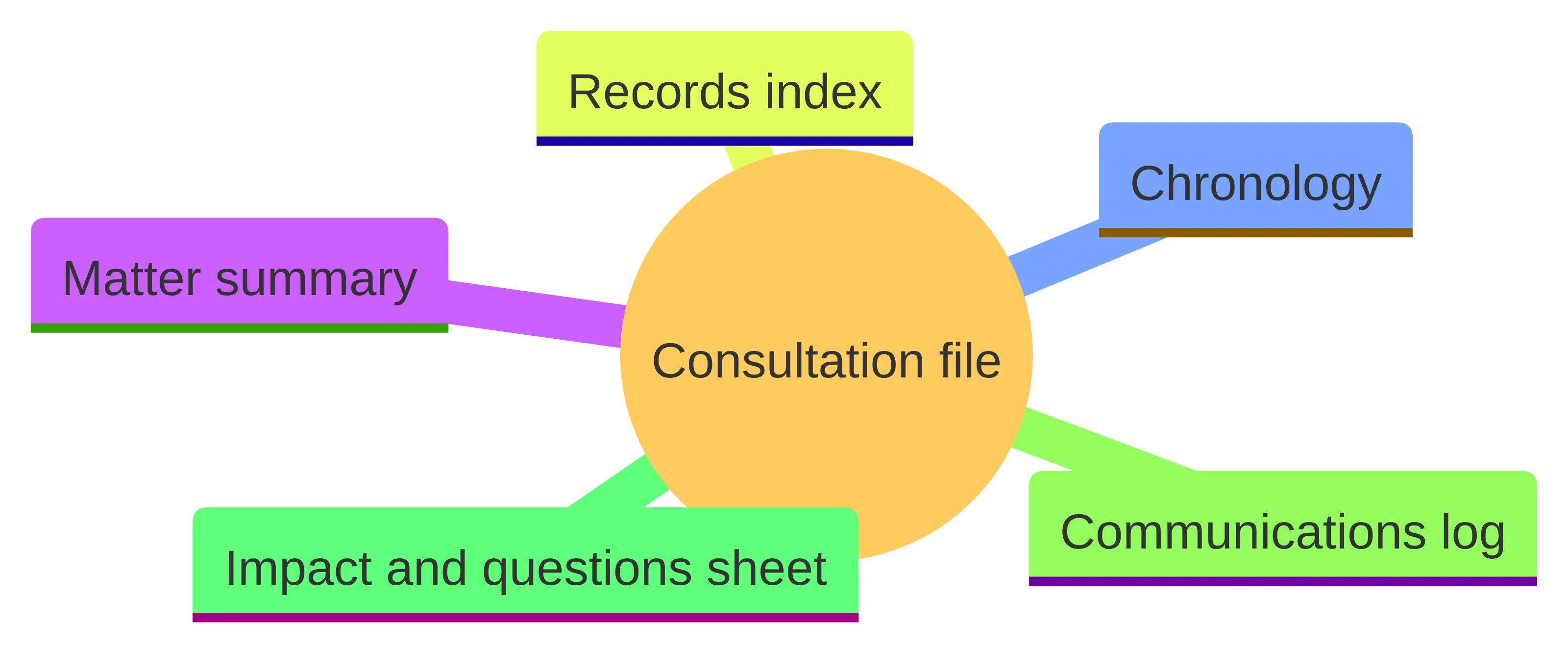
A five-part consultation file gives you a simple way to collect information without trying to prepare a complete legal case. Use one folder, notebook, or digital location with these five parts:
- Matter summary: Write a short account of the care, the health professional or facility involved, the main concern, and the outcome you want reviewed.
- Chronology: List appointments, tests, procedures, calls, changes in symptoms, follow-up, and later care in date order.
- Records index: List each record you have, the provider or facility connected to it, the date range, and whether you have the original, a copy, or only a reference to it.
- Communications log: Record messages, portal exchanges, letters, calls, complaints, explanations, and responses without converting them into conclusions.
- Impact and questions sheet: Describe symptoms, treatment, daily effects, work or household disruption, expenses you can document, and the questions you want to ask.
The file is an organizing aid. It does not need polished language, and it does not need to include every detail before you make contact.
The matter summary should fit on one or two pages and should name the subject in plain language. Begin with the approximate date or date range of the care, the location, and the health professional or facility. Then write what you expected, what you experienced, what happened next, and why you are seeking review now.
Use observable descriptions instead of legal conclusions. Write that a procedure was followed by a particular symptom, that a result was communicated on a certain date, or that a follow-up request received a particular response. If you are unsure about a date, mark it as approximate rather than guessing. A visible uncertainty is easier to investigate than a confident but inaccurate date.
If several people helped you remember what happened, distinguish your own recollection from what someone else told you. Note who supplied the information and whether a document supports it. That small distinction can prevent a secondhand account from being presented as something you personally observed.
The records index should work as a map rather than a second copy of every document. For each item, note the provider or facility, the general type of record, the relevant date range, and where you stored it. Include records you requested but have not received, and distinguish those from records you have not yet requested.
The communications log should follow the same discipline. Note the date, the person or office contacted, the subject, the response, and any promised follow-up. Save the message or letter when you can. If you remember a telephone conversation, label it as your recollection and record the words or substance as accurately as possible rather than presenting memory as a transcript.
Use a simple status label for each item: have, requested, pending, unavailable, or unknown. The labels do not decide the significance of a document. They show where the file needs attention and give you a quick way to explain its condition during the consultation.
The impact and questions sheet should describe what changed for you after the care. Separate symptoms from treatment, treatment from daily limitations, and daily limitations from financial effects. Include the dates or date ranges you can support. You do not need to calculate a legal value; you need to show what happened and where the effects appear in your records.
Finish with questions such as: Which missing records matter first? Which dates should be investigated? What information would help you explain the treatment? What should you preserve now? What would the next stage of review require? This list turns the consultation into a working conversation rather than a single request for a yes-or-no answer.
Keep a short list of terms you do not understand. Copy the wording from a record rather than guessing at its meaning, then ask about it during the consultation. This is especially useful when a report, discharge instruction, or later diagnosis uses language that differs from what you were told in person.
Build the timeline before interpreting the care
A medical-care timeline should show the sequence before it explains the sequence. Start with the earliest relevant symptom, appointment, diagnosis, procedure, prescription, test, referral, or communication. Continue through later treatment and the point at which you began to question the care.
Use a separate line for each event. Include:
- The date or an approximate date.
- The provider, office, facility, or person involved.
- What occurred or what you were told.
- What you did afterward.
- The record, message, bill, or witness that may support the entry.
A timeline can contain gaps. Mark a gap plainly and add what might fill it, such as a portal message, appointment record, discharge instruction, or later provider note. Do not fill a missing date because it seems to fit the surrounding events.
The timeline should keep facts and interpretations in different columns or paragraphs. A fact might be that you returned to a facility, reported a symptom, received a test, or were referred elsewhere. An interpretation might be that the symptom resulted from an earlier decision or that a response should have happened sooner. Keep the interpretation as a question until it has been reviewed.
This approach is especially useful when several providers or facilities were involved. A later diagnosis may explain why you are concerned, but it does not by itself establish what an earlier provider knew or should have done. Preserve the sequence first, then ask which parts require professional review.
Use a source beside each timeline entry. A record, message, bill, calendar entry, or personal recollection can identify where the date came from. If two documents show different dates, keep both entries and flag the difference instead of choosing one without explanation.
A neutral timeline entry might say: On or about March 4, you reported worsening pain to the office through the patient portal; the office replied that someone would contact you; you later attended another appointment on March 8. A separate question can ask whether the response and the later appointment require review. The entry preserves what happened without deciding what the response meant.
Avoid writing the timeline as an argument. Words such as ignored, concealed, or admitted may express your view, but they can blur the underlying event. Record the communication or conduct first, then identify the conclusion you want an attorney to examine.
Request and preserve the medical-record trail
New York patients may request their medical records, and the request must be made in writing. New York patients may also request copies, while providers may charge reasonable fees for inspection, shipping, and copying costs. Inability to pay inspection or copying costs alone cannot be used to deny access to the records. New York Department of Health guidance retrieved on October 28, 2026, supports these points, so treat the current procedure and any exceptions as matters to address during legal review.
Send a clear written request to each relevant provider or facility. Keep a copy of the request, the date sent, the delivery method, and every response. Ask for the categories and date ranges you need rather than assuming a single document contains the full history.
A written records request can identify the patient, the date range, the provider or facility, and the records sought. Depending on the care, your list may include office notes, hospital records, test results, imaging reports, procedure records, medication information, discharge instructions, referrals, and billing material. Request copies in a form you can preserve and review, and ask how the provider will deliver them.
Keep the request neutral. You are asking for records, not asking the provider to agree with your interpretation. If an office responds that a different department, facility, or records custodian holds the material, add that response to your log and direct a new written request as needed.
Request records from each relevant organization separately when the care moved between offices, hospitals, laboratories, pharmacies, specialists, or other facilities. A later provider’s file may refer to an earlier record without containing the full earlier record. Note those references in your index so you can ask where the underlying material is held.
Preservation starts when a record reaches you. Keep the original electronic file when possible, save a separate working copy for notes, and name files with the provider, document type, and date range. Do not edit the contents of a message, image, report, or portal export. Put your explanation in a separate note.
Create an index as records arrive. Mark duplicate copies, missing pages, unreadable files, and documents that refer to an attachment you do not have. Preserve envelopes, letters, portal notices, and delivery information when they help establish when a communication was sent or received. Bring questions about gaps to the consultation instead of silently discarding an incomplete set.
Do not let uncertainty about a copying charge prevent you from recording the request and discussing the problem during a consultation.
Keep a record of the date your request was sent and the response date. If a provider sends only part of what you requested, list what arrived and what remains outstanding. Partial production is easier to address when your index shows the original request and the missing categories.
Know what an attorney can request for you
A New York attorney may request records for a qualified person when the attorney has a signed power of attorney; an attorney without that authorization is not a qualified person under the Department of Health guidance. This means a consultation about records and a formal authorization to obtain records are related but separate steps.
Ask what authorization would be needed, whose records it would cover, and whether the request should identify particular providers, facilities, or date ranges. Read any authorization before signing it. Keep a copy with your consultation file and record when you delivered it.
The identity of the person whose records are sought can affect the process. If the records concern a child, a deceased patient, or another person whose information you manage, tell counsel that at the outset. Do not assume that your own access to a document gives you authority to request every related record.
You can still begin organizing records before deciding whether to authorize an attorney to request them. Make a list of every provider and facility, including names that appear on bills, discharge papers, portal messages, or referral documents. Note which organizations have already supplied records and which have not.
During the consultation, ask whether the existing material is enough for an initial review, which missing records should be prioritized, and whether a signed authorization would make a particular request more practical. The answer may depend on the type of record and the person whose information is involved. Treat authorization as a specific administrative step, not as permission to assume that every relevant document has been collected.
Bring the authorization question together with your records index. Counsel can then see which providers are involved, what you already have, and where an authorization may be needed. Keep the authorization separate from the original records so its scope and date are easy to find.
Preserve communications without turning them into proof
A communications log preserves the trail of what you asked, what you were told, and what happened afterward. Include calls with offices, messages through patient portals, letters, emails, billing disputes, complaints, requests for follow-up, and conversations with later providers. Record the date, the person or department, the topic, the response, and any next step that was promised.
Save the actual communication when possible. A portal screenshot, email export, letter, voicemail record, or call confirmation can give more context than a memory written weeks later. If you cannot preserve the original, write a dated note that identifies the communication as your recollection.
For telephone calls, write the note soon after the call and identify who participated, how you reached the office, and what you understood would happen next. Do not present the note as a recording or transcript. Its purpose is to preserve your account while the conversation is still clear.
A communication can show what was said or requested without resolving whether the care was negligent. Keep your description close to the words and circumstances you can support. Separate a statement such as the office told me to return from an interpretation such as the office admitted a mistake.
Do not delete an angry message, an incomplete reply, or a communication that seems unhelpful. Mark the context and preserve it with the rest of the file. If a communication contains information about another person, keep privacy concerns in mind and ask how to handle it before circulating the material broadly.
Preserve both sides of an exchange when you can. A message without the reply, or a reply without the question that prompted it, may be difficult to understand later. Keep attachments with the message that delivered them and note when an attachment was missing.
Describe symptoms, treatment, and losses concretely
A symptom record should show what you experienced, when it began or changed, how long it lasted, and what treatment followed. Use your own words alongside the clinical terms that appear in records. Note whether the symptom was new, worsened, intermittent, or connected in your mind to a particular event, while keeping that connection identified as your observation.
A useful entry can include:
- The date or date range.
- The symptom or functional change.
- What activity brought it on or made it worse, if known.
- Who you contacted and what response you received.
- Treatment, medication, testing, referral, or follow-up.
- The record that may support the entry.
Do not turn a symptom diary into a medical conclusion. Its purpose is to preserve detail that may be difficult to recall later.
Treatment entries should identify where care occurred and what you remember receiving or being told. Include visits with the original provider, later providers, emergency or urgent care, specialists, therapists, pharmacies, and facilities. Add changes in medication, repeated tests, referrals, missed appointments, and instructions that affected what you did next.
If a later provider used a different diagnosis or explanation, record the difference accurately. Do not decide in the timeline which explanation is correct. The contrast may be a question for the consultation, especially if it affects the sequence of care or the records you should request.
Separate what you were prescribed from what you actually took, if that distinction matters to the chronology. Record changes as you remember them and identify the source of each entry. Do not alter an original medication list to make it match your recollection.
A loss record should describe consequences without assigning a legal value. Note time away from work, changes in duties, help needed at home, transportation, out-of-pocket expenses, canceled plans, sleep disruption, and activities you could no longer perform. Keep receipts, wage information, schedules, bills, and other supporting material in a separate folder.
Use concrete comparisons. Instead of writing that daily life became impossible, describe which tasks changed, how often help was needed, and during which dates. If an effect is ongoing, mark the last date you updated the entry. This gives you a factual record for questions about the impact without promising that every effect will be treated the same way in a legal review.
Separate direct expenses from estimates and distinguish missed work from changes in ability to work. If someone helped you with household tasks, record the task, the dates, and the time involved. These details help you explain the effect of the care without trying to assign a legal category to every consequence.
Use the consultation to ask unresolved questions
A consultation question list should help you understand what will be reviewed, what information is missing, and what action comes next. Bring the list even if your written summary feels complete. A conversation may reveal a date, provider, or document that you did not recognize as relevant.
Start with questions about scope:
- What parts of my account require further review?
- Which providers, facilities, or entities should be included in the records search?
- Which records are most important to request first?
- Which facts are still unclear or need independent confirmation?
- What should I preserve while the review continues?
Write down the answers and distinguish a confirmed next step from a possibility that still requires investigation. If counsel asks you to supply another record or date, add it to your file immediately after the conversation.
Ask specifically which timing questions apply to your circumstances. The timetable is a general legal reference, not an individualized calculation, and exceptions or different facts may matter.
Ask which dates should be investigated, including the date of the care, the date you learned relevant information, the end of continuous treatment if that concept may apply, and any later care connected to the same condition. Bring the records that support each date. Do not choose a filing date from a general timetable alone.
Ask practical questions about communication and process as well. You can ask who will be your point of contact, how documents should be sent, how questions will be handled after the first meeting, and what information is needed before a further review. You can also ask what the attorney cannot determine at the first conversation.
The answers help you understand the path without demanding a prediction. Keep notes during the consultation and label them as your notes, especially when the discussion includes possible next steps rather than settled conclusions.
You may also ask what happens if new records arrive after the consultation, whether you should continue requesting records yourself, and how to flag a timing concern. These questions are about process. They do not require you to decide the merits before the review is complete.
Treat New York timing as an urgent verification issue
New York timing deserves prompt attention because the relevant dates may depend on the particular provider, entity, condition, illness, injury, and treatment sequence.
That statement does not calculate your deadline. It identifies a time-sensitive question for a New York attorney to examine under current law and the facts of your matter. The timetable should not replace a prompt consultation, especially when you are unsure about the date of care, the end of treatment, the identity of the relevant entity, or whether an exception may affect the analysis.
Create a timing file with the dates that could affect review. Include the first relevant appointment, procedure, test, prescription, discharge, follow-up, complaint, later diagnosis, and last treatment connected to the condition or injury. Add the date you requested records and the date you received them. Mark each date as exact, approximate, or still unknown.
Put the source beside each date. A billing entry, appointment reminder, portal message, discharge instruction, medical record, or personal diary may help locate an event, but your attorney will decide what significance the date has. Do not erase an uncertain entry; preserve it and explain why it is uncertain.
If you are unsure which entity provided care, list every name that appears in your records. A facility, professional practice, individual health professional, or related organization may appear under different names. Let counsel examine that question rather than simplifying the list yourself.
Contact counsel promptly when a possible deadline is part of your concern. Bring the timing file rather than waiting to create a perfect chronology. If records are still pending, bring proof of the requests and identify the missing providers. If you have already received a notice, filed a complaint, signed an authorization, or spoken with another attorney, include that information and the relevant dates.
Do not wait for every record before raising a timing concern. Tell counsel which dates are confirmed, which are approximate, and which are missing. The immediate objective is to put the timing issue in front of counsel with the facts you can presently identify.
Do not rely on proposed legislation as current law
A 2017 New York Senate bill proposed an attorney certificate stating that the facts had been reviewed, a knowledgeable licensed physician had been consulted, and there was a reasonable basis to begin a medical-malpractice action, with a time-limit exception. The selected bill passage does not establish that the proposal became enacted law or that its language governs your matter.
Treat the proposal as legislative history, not as an instruction for preparing your consultation. Ask about the requirements that apply under current New York law instead of copying a proposed certificate into your file.
A bill can describe proposed language without telling you whether the language took effect, was amended, or applies to your circumstances. Keep that distinction visible in your notes. Do not use a proposal to decide what must be filed or when.
A 2025 New York Senate bill proposed requiring, in certain professional-malpractice or negligence actions, an affidavit from a knowledgeable licensed professional in the same profession as the defendant to accompany an attorney certificate. The selected passage likewise does not establish enactment or current applicability.
Your practical step is simple: preserve the source if it explains why you have a question, but do not treat a bill as a current filing rule. Ask a New York attorney which procedural requirements, if any, apply to your circumstances and when they must be addressed.
Keep proposed-law questions separate from the factual file. Your chronology and records describe what happened; a legislative proposal describes language that was introduced. Those are different kinds of information and should not be blended.
Separate documented firm fit from a promised result
Firm fit begins with whether the practice handles the type of concern you want reviewed. We handle medical-malpractice cases, and we represent people seeking legal help with suspected medical negligence. Those are documented descriptions of our service, not a promise that we will accept every matter or that a particular result will follow.
Use the consultation to ask whether your account falls within the type of work we review, what information is needed to assess it, and what the next step would be. Bring the five-part file so the discussion can focus on your actual records, chronology, communications, and questions rather than on a general description of medical malpractice.
You can also evaluate fit through the clarity of the conversation. Notice whether your questions are answered in terms you understand, whether uncertainties are identified rather than covered with certainty, and whether you know what information to send next. Ask how to communicate about additional records, changed symptoms, new treatment, or a timing concern.
Do not use a confident prediction as the only measure of fit. A responsible initial review may leave important questions open while identifying what must be investigated. Your decision can rest on the documented service fit, the practical communication process, and your understanding of the proposed next step.
A consultation cannot promise that your matter will be accepted, that negligence will be established, or that compensation will result. Keep those questions separate from the narrower question of whether the practice can review the concern and explain what information is needed. That distinction lets you seek help without treating contact itself as a prediction.
The consultation decision is therefore narrower than a decision about the final legal outcome. You are deciding whether to present the organized facts for review. Counsel can then explain what remains to be investigated and which next step is appropriate.
Run the readiness check before contacting counsel
A readiness check should confirm that your consultation file is usable, not that it is complete. Before contacting counsel, check each item:
- Basic account: You can explain the care, the concern, and the outcome in a few paragraphs.
- Provider map: You have listed the health professionals, practices, facilities, and later providers you can identify.
- Chronology: Major events are in date order, with approximate or missing dates marked honestly.
- Records index: You know what you have, what you requested, what is pending, and what may be missing.
- Communications log: Important calls, messages, letters, complaints, and responses have dates and sources.
- Impact notes: Symptoms, treatment, daily effects, work or household changes, and documented expenses are separated by category.
- Timing file: Relevant care and treatment dates are easy to find.
- Questions: You have written questions about review, records, timing, communication, and next steps.
- Privacy: You have stored the file securely and separated your own notes from the original records.
Stop when the file is clear enough to explain. More pages are not automatically more useful.
Gaps should be visible before the consultation. Mark records that have not arrived, dates that depend on memory, providers whose names are incomplete, communications you cannot retrieve, and consequences you have not yet documented. Add one sentence explaining how you may locate each missing item.
Do not delay contact merely because a record is pending or a date is uncertain. Tell counsel what is missing and show the written request or other lead. A clear gap can produce a useful question; a hidden gap can make the chronology appear more certain than it is.
Prepare a short handoff note for the initial contact. Include your name and contact information, the New York location of the care if relevant, the general date range, the providers or facilities involved, the main concern, and whether any timing issue feels urgent. Avoid sending a large unorganized collection of documents unless you are asked to do so.
Keep your full file available for the consultation. Send only through the communication method provided for the matter, and retain a copy of everything you submit.
Before sending, read the handoff note once for accuracy. Check names, dates, phone numbers, and email addresses. Mark approximate dates as approximate and make sure a question has not accidentally been written as a conclusion.
Request the consultation with the organized file
A prepared consultation gives you a clear place to put the facts, records, dates, communications, and questions surrounding suspected medical negligence. Organize what you know, mark what remains uncertain, and raise New York timing promptly rather than trying to decide the legal result by yourself.
What should I bring to a medical malpractice consultation?
What should I prepare before contacting a medical malpractice attorney in New York?
Before contacting an attorney, prepare a consultation file that includes a summary of your case, a chronology of events, an index of relevant records, a log of communications, and a list of questions you want to ask. This organization will help facilitate a productive consultation.
How can I request my medical records in New York?
In New York, you can request your medical records by submitting a written request to your healthcare provider. Be sure to specify the records you need and keep a copy of your request for your records.
What types of cases do medical malpractice attorneys handle?
Medical malpractice attorneys handle cases involving negligence by healthcare professionals that result in harm to patients.
What information should I gather for my consultation with a medical malpractice attorney?
Gather information such as the timeline of events, names of healthcare providers, any medical records you have, details of communications with providers, and a list of symptoms or changes in your condition.
What should I expect during my initial consultation with a medical malpractice attorney?
During your initial consultation, you can expect to discuss the details of your case, review the information you have gathered, and ask questions about the legal process and potential next steps.
Keep reading
More on Medical Malpractice
 Medical Malpractice
Should You Contact a New York Medical Malpractice Lawyer? How to Prepare for a Consultation
Prepare for a New York medical malpractice consultation with a clear timeline, key records, and focused questions.
Read article Medical Malpractice
4 Essential Qualities of Medical Practice Lawyers You Need
Discover the key qualities to look for in medical practice lawyers for effective representation.
Read article Medical Malpractice
4 Steps to Find Lawyers Who Deal with Medical Negligence
Find experienced lawyers who deal with medical negligence to secure the justice you deserve.
Read articleHurt like this?
Tell us what happened.
We handle Medical Malpractice cases across Long Island, Queens and New York City. The consultation is free and you pay nothing unless we win.
- Answered 24/7
- No fee unless we win
- Hablamos español
Send us the details
Takes about a minute. Free and confidential.