Slip & Fall
Slip and Fall Attorney Los Angeles: How to Prepare for a Consultation and Compare Your Options

Turn the fall into a consultation decision
A Los Angeles slip-and-fall consultation should help you turn a confusing event into a set of questions about the condition, the property, the injury, the timing, and the people or entities involved. The immediate decision is not whether you can predict the result of a claim. The immediate decision is whether you have enough organized information to contact qualified California counsel and use that conversation productively.
Start with four questions: What happened? What evidence still exists? Who controlled the area? What timing issue could affect the next step? Your answers do not need to be complete. They give an attorney a workable starting point and help you compare whether the explanation you receive is clear, specific, and grounded in California premises-liability rules.
A consultation-ready review follows a practical order:
- Write a dated account of the fall, including where you were, what you encountered, what happened immediately afterward, and who was present.
- Preserve photographs, videos, messages, incident reports, witness details, medical records, bills, and other material connected with the event.
- Identify the owner, tenant, business, manager, maintenance provider, or public entity connected with the area, without assuming that the titleholder was the only responsible party.
- Separate a private property incident from a fall on public property because the available procedure and timing may differ.
- Compare California attorneys by premises-liability experience, State Bar standing, communication, fit, and clearly explained engagement terms.
A fall on another person’s property does not automatically establish liability. A qualified California attorney can evaluate whether the available facts justify further review without promising a result. Bring the organized record, ask how the attorney would test the main issues, and use the answers to decide your next step.
See what a California attorney will evaluate
A California premises-liability review generally connects six related questions: who controlled the property, what dangerous condition existed, what the responsible party knew or should have discovered, whether reasonable care was used, whether the condition caused the injury, and what injuries and losses followed. A California premises-liability claim generally requires evidence about property control, a dangerous condition, notice, failure to use reasonable care, causation, injuries, and damages.
The accident itself is only the starting point. California premises-liability claims generally require proof of negligence that was a substantial factor in causing the injury, so the consultation should examine the link between the condition and the harm rather than treating the fall alone as proof of responsibility.
Potentially responsible parties may include a property owner, tenant, business operator, property manager, or another person or entity exercising control over the property. More than one party may share responsibility, including an owner, landlord, tenant, property manager, or maintenance contractor, depending on who controlled the area.
That question changes how you prepare. A store may occupy leased space while a landlord controls structural features or a contractor handles maintenance. A residential building may involve an owner, manager, tenant, and vendor with different responsibilities. Tell the attorney every name and role you know, even when you are unsure which relationship matters. The consultation can then focus on control of the precise place where the fall occurred instead of relying on a broad assumption about ownership.
Use the consultation to ask how the attorney would analyze these points:
- What condition is alleged to have caused the fall, and what evidence describes it?
- What facts could show that the responsible party knew about the condition or should have found it?
- Which person or entity controlled inspection, repair, warning, or maintenance in that location?
- What evidence connects the condition to the injury rather than to another event?
- Which losses are documented, and which losses still need records?
A useful answer should distinguish what is known from what still needs investigation. It should also identify the facts that could support or weaken each part of the analysis.
Connect the condition to notice
A dangerous property condition can take many forms, including uneven walking areas, icy or slippery surfaces, and loose tiles or carpeting. Describe the condition in physical terms rather than using only a conclusion such as “the floor was unsafe.” Note its location, size, color, texture, lighting, surrounding objects, and whether it changed before or after the fall.
Photographs should show both the detail and the surrounding area. A close image may show a raised edge or wet surface, while a wider image may show the route you took, nearby warnings, visibility, stairs, entrances, or other features that help locate the hazard. Keep the original files and record when, where, and by whom each image was made.
California liability generally requires showing that the owner had actual or constructive notice of the dangerous condition - either the owner knew about it or should have discovered it through reasonable inspection. Actual notice means the owner knew about the hazard; constructive notice means the owner should have discovered it through reasonable inspection.
Your account should therefore include more than the moment of impact. Record anything you know about when the condition began, whether employees, tenants, security personnel, or other visitors saw it, whether anyone complained, and whether a repair, inspection, warning, or cleanup occurred. Witness names, messages, posted notices, incident reports, and surveillance may help establish the history of the condition. A dated complaint or maintenance record may help an attorney evaluate notice when the record identifies the hazard, its location, or when it was observed. Preserving a complete complaint or maintenance record, with its source and date, helps an attorney assess context rather than an isolated excerpt.
A California hazard left unaddressed long enough to have been found through ordinary care can support liability even without proof that the owner actually saw it. That possibility makes timing details useful. A witness who noticed the condition earlier, a maintenance entry, a complaint, or a recurring defect may matter even when nobody admits seeing the hazard before the fall.
Do not fill gaps with guesses. Mark each detail as something you personally observed, something another person told you, or something shown by a record. That distinction gives the attorney a clearer basis for deciding what should be requested or investigated.
Relate the fall to injury and loss
The injury-and-loss portion of a California premises-liability review asks how the condition connects to the harm and what monetary losses followed. The dangerous condition must be connected to the injury, and damages may include monetary losses such as lost income or medical bills.
Build a simple chronology from the fall through appointments, restrictions, changes in daily activities, missed work, bills, and payments. Keep copies of records and note dates rather than relying on memory. If an account describes pain or limitations, connect it to the date and activity involved. The purpose is to give the attorney a usable record of what changed after the event, not to assign a value to the claim yourself.
Falls can cause traumatic brain, spinal and back, fracture, soft-tissue, neck and shoulder, and internal injuries. The kind of injury does not by itself establish who is responsible, but it affects the records and timeline that deserve attention.
Keep appointment information, restrictions, bills, test results, work records, receipts, and notes about assistance or activities affected. If your records use medical terms you do not understand, list the terms and ask the attorney how they fit into the legal review. Do not omit an injury because it appeared later or because it seemed less serious at first; describe when you noticed it and how it affected you.
Preserve the early evidence
After a fall, obtain appropriate medical care promptly. Seek immediate qualified medical help for urgent or concerning symptoms, and keep the resulting appointment information, restrictions, bills, and records. Early evidence preservation for a California premises-liability matter combines scene documentation, maintenance records, witness testimony, medical evidence, and a prompt request to preserve surveillance footage and other records. Work through the following checklist as soon as you reasonably can:
- Record the scene. Save photographs or video of the condition, the surrounding area, lighting, entrances, stairs, warnings, and the route you took. Write down the date, approximate time, weather if relevant to what you observed, and the exact location.
- Identify witnesses. Save names, phone numbers, email addresses, and a short note describing what each person saw or heard. Keep the note separate from a statement presented as a final account.
- Preserve communications. Keep texts, emails, online messages, calls documented in your notes, incident-report information, and any communication with an owner, tenant, manager, insurer, or public agency.
- Organize medical evidence. Gather appointment information, restrictions, bills, records you have received, and information showing how the injury affected work or ordinary activities.
- Keep the original material. Store original photographs, videos, messages, and documents without editing them. Make working copies for notes and organization.
A dated losses file should include appointments, restrictions, mileage, receipts, missed work, assistance required, and activities affected. Add a short entry whenever a treatment appointment, restriction, expense, missed shift, or change in activity occurs.
A dated file is more useful than a stack of disconnected documents because it lets you place the fall, notice evidence, treatment, expenses, and communications in order. Keep factual observations separate from estimates or conclusions. If an amount is uncertain, label it as an estimate and preserve the document that may later establish the amount.
Evidence preservation does not require you to investigate beyond your access or confront anyone at the property. Save what you already have, identify what may exist elsewhere, and tell the attorney what you could not obtain. Do not alter photographs, delete messages, discard footwear or clothing connected with the incident, or sign a statement or agreement without understanding what it says and why it is being requested.

Map who controlled the area
Property control in a California premises-liability matter may be different from title ownership. Identify who controlled the particular area rather than assuming that the titled owner was solely responsible. Potential participants may include a landlord, tenant, business operator, property manager, maintenance contractor, or another entity with authority over the condition.
Start your map with the exact place of the fall. Then note who appeared to control access, cleaning, inspection, repairs, warnings, lighting, snow or water removal, security, or other relevant work. The purpose is not to decide responsibility in advance. The purpose is to prevent a key relationship from disappearing because the first name you found was the property owner.
When available, leases, management agreements, permits, vendor contracts, and insurance correspondence may help identify control. Save the documents you already possess and record where you saw a reference to another owner, tenant, manager, contractor, or insurer. Do not assume that an unavailable document proves that no relationship existed.
Bring the map to the consultation with open questions: Who had the duty connected with the precise area? Was maintenance assigned to someone else? Did a tenant control the space while a landlord controlled a common area? Did a contractor perform inspections or repairs? A clear map helps the attorney decide which records, witnesses, or entities require further review.
Separate public-property timing from ordinary timing
Public-property status creates a separate timing and procedure question for a California fall. A claim involving a California public entity commonly requires a government claim within 6 months, followed by additional procedural deadlines. The 6-month period measures the time commonly allowed for the government claim in a matter involving a California public entity; it is not a universal deadline for every California injury claim.
A claim against a California government entity also requires evidence addressing the public-property danger, causation, foreseeability, and whether the entity knew or should have known about the hazard or a government employee created it through negligence.
California generally provides 2 years for a personal injury lawsuit, but exceptions can shorten or alter that period. The 2-year period describes the general California timeframe for a personal-injury lawsuit, not a promise that every fall claim receives that amount of time or follows the same procedure.
Do not choose a deadline by counting from memory or by applying an ordinary private-property rule to a public-property incident. Identify the date of the fall, the property owner or operator, every public connection you know about, and any communications already received. Give those facts to qualified California counsel promptly so the applicable timing and claim steps can be assessed.
If the fall happened on public property, call a lawyer immediately. Treat that instruction as a timing safeguard, not as a conclusion that you have a viable claim. A prompt discussion can focus on identifying the public entity, locating the correct procedure, preserving records, and determining which dates require attention.

Prepare for defenses about visibility and control
A defendant may argue that a hazard was open and obvious. That argument can excuse a failure to warn, but it does not automatically excuse failing to fix a known hazard when the danger remained foreseeable.
Prepare to discuss what was visible from your approach, whether lighting or objects affected visibility, whether the condition blended into the surrounding surface, whether a warning existed, and whether avoiding the hazard was realistic in the circumstances. A photograph taken from the walking path may answer a different question from a close photograph taken after the fall. Preserve both perspectives when they are available.
A defendant may also argue that it did not own, lease, or control the area where the injury occurred. California premises liability generally extends responsibility beyond titleholders to people or entities that manage or control the property. More than one party may share responsibility for the same hazard, including a landlord, tenant, property management company, or maintenance contractor.
Ask the attorney how the control question will be investigated and which document or witness could answer it. Bring names from signs, receipts, emails, lease references, maintenance notices, or incident reports. The answer may depend on the specific corner, walkway, stairway, entrance, or common area where the fall occurred rather than on the property as a whole.
Use these questions to make the discussion concrete:
- What facts support the position that the hazard was visible, and what facts address whether it was still foreseeable?
- Who had authority to repair, inspect, clean, warn, or control the exact area?
- What record could show when the condition appeared or who knew about it?
- Which argument depends on a disputed fact rather than an established record?
- What additional information would materially change the evaluation?
A clear explanation should address unfavorable facts as well as favorable ones. You are comparing the quality of the analysis, not seeking a promise that a defense will fail.
Bring a usable consultation file
A usable consultation file lets a California attorney follow the event without reconstructing every detail from scattered papers. Arrange the file in dated sections:
- Incident chronology: location, route, condition, fall, immediate symptoms, reports, and people present.
- Scene material: photographs, videos, diagrams, measurements you already have, clothing or footwear information, and notes about lighting or warnings.
- Witnesses: names, contact details, and what each person may have observed.
- Property and control: owner, tenant, manager, business, contractor, public entity, signs, receipts, and communications identifying who operated or maintained the area.
- Medical information: appointments, restrictions, records received, bills, tests, and changes in symptoms or activities.
- Losses: mileage, receipts, missed work, assistance required, and activities affected.
- Communications: incident reports, messages, insurance letters, preservation requests, and responses.
A dated file should contain appointments, restrictions, mileage, receipts, missed work, assistance required, and activities affected. Use a contents page if the file is large, and label each document with its date and source without writing conclusions on the original.
For example:
- Which facts do you need clarified before evaluating the condition and notice?
- Who might have controlled the area, and what records could establish that relationship?
- What timing or public-entity issue should be addressed first?
- What evidence should be preserved or requested now?
- How would you explain the principal weaknesses as well as the supporting facts?
- What would the engagement cover, how would expenses be handled, and when would the arrangement be confirmed in writing?
Write down the answers and any follow-up documents requested. A consultation becomes more useful when you leave knowing what remains uncertain and what practical step addresses each uncertainty.
Compare California attorneys by verification and fit
California attorney comparison should begin with authorization and relevant experience, then move to communication and fit. A certified California Lawyer Referral Service refers people to lawyers experienced in the appropriate field of law who are State Bar licensees in good standing. Lawyers included in a certified California Lawyer Referral Service must carry professional liability insurance.
The State Bar of California’s online certified specialist directory allows you to search for a certified attorney by specialty area and California county. That directory is one way to locate information about a specialty designation; it does not decide which attorney fits your circumstances. Ask each attorney about experience with premises-liability matters, who will handle communication, how updates will be provided, and whether the attorney can explain the issues in language you understand.
Use the same questions with every attorney you contact:
- Is the attorney authorized to practice in California and in good standing?
- How does the attorney approach property control, notice, causation, injuries, damages, and public-property timing?
- Who will be your regular contact, and how will you receive material updates?
- Does the attorney explain uncertainty and unfavorable facts directly?
- What does the proposed engagement cover, and which expenses are separate?
- Do you understand the arrangement well enough to decide without pressure?
Virtually all personal-injury attorneys offer free initial consultations; during the consultation, the attorney evaluates your case and you evaluate the attorney, and you should not pay for the initial consultation. Use that conversation to assess communication as well as legal analysis. A confident tone is not a substitute for a specific explanation.
Relevant premises-liability experience is only one comparison point. A lawyer may have experience with a different property type, a different injury, or a different defendant structure, so ask how that experience relates to your facts. Communication fit also matters: you should know who answers questions, how quickly routine updates are handled, and how decisions will be discussed.
Do not choose based solely on a slogan, a projected recovery, or a promise that a defense will not matter. Prefer a conversation that identifies the facts supporting the claim, the facts requiring investigation, the records that could change the analysis, and the terms you would be accepting.

Understand what representation may cost
California does not set one mandatory contingency-fee percentage for an ordinary slip-and-fall injury claim; you can discuss the proposed percentage with the attorney before agreeing to representation. In California, a slip-and-fall lawyer commonly takes about 33% to 40% of the recovery under a contingency-fee agreement, although the percentage varies and is negotiable.
A contingency fee means the lawyer receives an agreed percentage of your recovery if your claim succeeds; it generally requires no upfront attorney fee, and the percentage is set out in your agreement. With a contingency fee, you pay the lawyer a percentage of money received if you win or settle, but you may still have to pay some or all court costs and other expenses whether you win or lose.
The percentage is only one part of the cost. The amount you ultimately receive also depends on case expenses, medical liens, and other repayment obligations. Ask for a plain-language explanation of each category and when it is deducted.
An agreement may specify 33.33% (one-third) if the case settles before a lawsuit is filed and 40% if a lawsuit is filed and the case goes through litigation; the percentage varies if the case goes to trial or appeal, depending on the agreement. The 33.33% figure measures the lawyer’s share under an agreement for a pre-lawsuit settlement, while the 40% figure measures the share under an agreement for a filed case that proceeds through litigation. Those figures are examples of terms an agreement may contain, not a required California rate.
Ask whether the proposed percentage changes when a lawsuit is filed, when a matter proceeds to trial, or when an appeal occurs. Ask whether expenses are deducted before or after the percentage is calculated and whether medical liens or other repayment obligations are treated separately.
By law, a written fee agreement is required when the lawyer expects fees and costs for your case to total $1,000 or more. Before agreeing to a contingency fee, make sure the written agreement specifies the lawyer’s percentage and whether the share is calculated before or after other costs are deducted.
A lawyer’s fee arrangement may be fixed, hourly, a retainer, or contingent. Ask what a fixed fee includes and whether other charges may be added, and remember that an hourly matter may require more time than initially expected. For a slip-and-fall matter, ask specifically about filing fees, records, experts, investigators, deposition costs, service costs, medical liens, and expenses that could remain your responsibility if the matter does not succeed. Do not rely on a verbal description when the written agreement uses different terms.

Compare alternatives before deciding
Your next step can take more than one form. You can contact a California premises-liability attorney directly, speak with more than one attorney before choosing, or use a certified California Lawyer Referral Service to help identify an appropriate path. A lawyer referral service may help determine whether your problem can be resolved without a lawyer, including through a community mediation program.
A certified California Lawyer Referral Service may refer you to a local lawyer who handles your type of legal issue. The lawyer will offer an initial consultation for a reduced fee or no fee, and you are not obligated to hire that lawyer. The service can therefore be a route to an initial conversation without making the referral itself a commitment to representation.
A certified California Lawyer Referral Service may also be able to refer you to a bilingual attorney or an attorney offering reduced rates depending on your income.
| Path | What you can use it for | What to compare or clarify |
|---|---|---|
| Direct contact with a California attorney | Present the incident, evidence, control questions, timing, and proposed engagement terms to an attorney you locate | California authorization, premises-liability experience, communication, fit, fees, expenses, and the written agreement |
| More than one initial consultation | Compare explanations of notice, control, causation, public-property timing, evidence needs, and engagement terms | Whether each attorney identifies uncertainty and explains the same facts consistently or identifies different issues |
| Certified California Lawyer Referral Service | Seek help deciding whether a lawyer is needed or receive a referral to a local lawyer handling the legal issue | The referral service’s process, consultation terms, the lawyer’s experience, and whether you want to continue after the consultation |
| Community mediation or another nonlawyer route | Explore whether the problem may be resolved without a lawyer when that type of resolution fits the circumstances | Whether the route addresses the injury, evidence, responsible-party, and timing questions in your situation |
The alternatives are not interchangeable. A referral service may help with routing and initial access, while a direct attorney consultation focuses on the legal and factual questions in your incident.
Choose the path that gives you a clear way to address the facts that matter. If you use a referral, remember that the referral does not require you to hire the referred lawyer. If you contact attorneys directly, use the same questions and organized file so the comparisons are meaningful.
Request an evaluation when timing or responsibility is unclear
You do not need to resolve notice, control, causation, damages, or public-property procedure on your own before seeking qualified help. Gather what you have, avoid changing or discarding relevant material, and choose a next step that gives you a clear explanation of the issues and the terms under consideration.
What should you ask during a Los Angeles slip-and-fall consultation?
Does a Los Angeles slip-and-fall claim require proof that the property owner actually knew about the hazard?
Not necessarily. California premises-liability evidence may establish actual notice, meaning the owner knew about the hazard, or constructive notice, meaning the owner should have discovered it through reasonable inspection. The condition must also be connected to the injury, and the claim generally requires evidence of negligence, damages, and control of the area.
What changes when a slip and fall happens on public property in California?
A claim involving a California public entity commonly requires a government claim within 6 months, followed by additional procedural deadlines. California generally provides 2 years for a personal-injury lawsuit in other circumstances, but exceptions can shorten or alter that period. Identify whether a public entity was involved and seek qualified California legal review promptly rather than applying an ordinary deadline.
How much does a slip and fall attorney Los Angeles typically charge?
California does not require one contingency-fee percentage for an ordinary slip-and-fall claim. A California slip-and-fall lawyer commonly takes about 33% to 40% of the recovery under a contingency agreement, although the percentage is negotiable. Some agreements specify 33.33% of the recovery if the case settles before a lawsuit is filed and 40% if a lawsuit is filed and proceeds through litigation; the agreement controls. Ask how expenses, medical liens, and other repayment obligations affect the amount you receive, and whether deductions occur before or after the lawyer’s percentage.
How can I verify and compare a California premises-liability attorney before hiring one?
Confirm that the attorney is authorized to practice in California and consider using a certified California Lawyer Referral Service, which refers people to State Bar licensees in good standing; participating lawyers must carry professional liability insurance. Ask each attorney about premises-liability experience, who will communicate with you, how updates will be handled, what the engagement includes, and which expenses are separate.
Keep reading
More on Slip & Fall
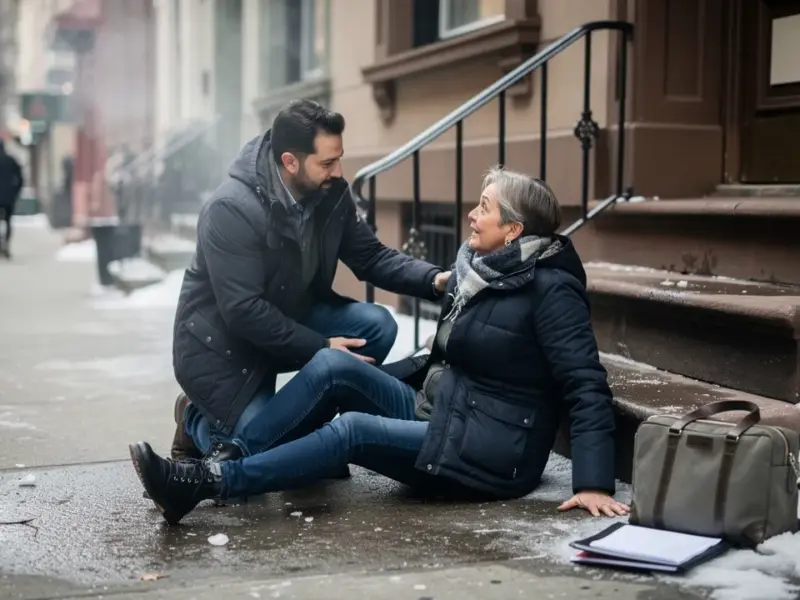 Slip & Fall
Slip and Fall Injury: What to Do After a Fall in New York
Learn what to do after a slip and fall injury in New York, when to seek care, preserve evidence, and consider legal review.
Read article Slip & Fall
How to Choose a New York Trip and Fall Attorney: A Consultation Decision Guide
Learn how to choose a New York trip and fall attorney, preserve evidence, compare fees, and prepare for a focused consultation.
Read article Slip & Fall
Queens Slip and Fall Attorney: A Decision Guide for Injury Victims
Learn what to preserve after a Queens fall, how New York notice rules can vary, and when legal representation may help.
Read articleHurt like this?
Tell us what happened.
We handle Slip & Fall cases across Long Island, Queens and New York City. The consultation is free and you pay nothing unless we win.
- Answered 24/7
- No fee unless we win
- Hablamos español
Send us the details
Takes about a minute. Free and confidential.