Slip & Fall
Premises Liability Attorney New York: A Consultation Guide for Property Injury Claims
Start with the property and the event
A New York premises liability claim may arise when a hazard on someone else’s property causes an injury and the owner or manager knew, or reasonably should have known, about the danger and did not fix it. That description can cover a fall in a store, apartment building, stairwell, sidewalk, or another location you had a reason to enter. A consultation may help you identify who controlled the property, what condition caused the injury, and what facts require prompt attention.
The first question is not whether you can prove negligence on your own. The first question is who controlled the place where you were hurt and what happened there. Write down the property address, the precise area, the date and approximate time, and why you were present. Those details can separate a private-property question from a public-property question before an important deadline passes.
Property-related injuries can involve wet floors, icy walkways, uneven surfaces, loose carpets, or poorly maintained stairs. The responsible party may be a landlord, property owner, business owner or manager, security company, maintenance or elevator contractor, city, or public agency, depending on the location and the facts. Start by writing down the exact address, the part of the property where you were hurt, what you were doing there, and who appeared to control that space. That basic map gives you a clearer path for choosing whom to contact and what records to preserve.
A broken stair rail, an unmarked wet floor, an unsafe sidewalk, a poorly maintained entrance, or a condition inside public housing may raise different investigation questions. Do not discard the possibility of more than one responsible party simply because you first spoke with a store employee, landlord, building manager, or public worker. Preserve the names and descriptions you have, then allow a qualified New York attorney to sort out ownership, control, maintenance, and notice.
Separate private-property and public-property paths
A New York negligence claim requires proof of a duty, a breach, and an injury that was the proximate result of the breach. Your first task is not to decide whether you have proved those elements; it is to identify the property setting and preserve the facts that allow an attorney to analyze them. Record whether the location was a privately owned home, apartment building, store, restaurant, workplace, sidewalk, public-housing property, transit facility, or another government-related site.
The name on a lease, receipt, sign, utility box, transit vehicle, maintenance notice, or building entrance may help identify the possible property controller. Keep a photograph of that information if you can do so safely. A property owner, a tenant, a managing agent, a contractor, and a public authority may have different roles, so describe what each person or organization appeared to do rather than choosing a legal conclusion.
Your status on the property can affect the owner’s duty and the outcome of a premises liability claim. New York premises guidance generally discusses three categories: an invitee, a licensee, and a trespasser. Invitees include people invited onto property for the owner’s commercial benefit, such as store customers and contractors performing work; the applicable guidance describes the owner’s duty to invitees as the highest and includes maintaining the property, posting clear warnings, and taking measures to prevent injuries. Licensees have permission to be present for social rather than commercial reasons. That guidance states that an owner must warn licensees about known hazards and address issues that could cause serious harm, but does not have a duty to inspect for hazards. Do not assign yourself a category from a short description; preserve the circumstances for legal review.
Your reason for entering, any permission you received, your relationship with the property owner, and what you were doing when the injury occurred may all matter. A delivery worker, customer, guest, tenant, contractor, or person who entered without permission may present different facts. Put those facts in your timeline without labeling yourself.
A public-property path needs separate attention because New York statutes impose notice and timing requirements for covered claims against public entities. A sidewalk beside a private building, a city sidewalk, public housing, a transit facility, and a state highway may involve different defendants and service procedures. Write down the name displayed on signs, notices, buildings, vehicles, or transit equipment, and keep photographs of those identifying details. Then tell the attorney exactly which public body or authority appears connected to the location.
Use a separate heading in your notes for the public-property question. Include the location, the agency or authority name, the incident date, and every notice or report you received. That organization can help an attorney determine which notice procedure and deadline require attention.

Treat the first hours as evidence work
Your immediate health and safety come first after a property injury. Address urgent medical needs, move away from an ongoing danger when you can do so safely, and make a brief note of what happened while the sequence is still clear. If you can document the location without putting yourself or anyone else at risk, preserve the scene as you found it rather than cleaning, repairing, moving, or discarding anything connected to the incident.
Report the incident to the appropriate property contact when doing so is safe, and keep a copy or photograph of anything you are asked to sign or receive. A report can identify the time, location, and people who responded, but it does not replace your own account. Write down what you observed before speaking with others so your notes distinguish your observations from later statements.
Premises liability claims often depend on time-sensitive evidence such as surveillance footage, maintenance logs, witness statements, and property records. A property owner may repair a hazard, delete surveillance footage, or update maintenance logs within days of an accident. Those possibilities make prompt documentation and legal contact practical priorities, especially when you do not control the property or its records.
Ask a property manager or business whether surveillance exists, but do not assume that a verbal assurance preserves it. Record who you spoke with, when you asked, and what response you received. An attorney can decide what preservation request or investigation fits the facts.
Your first record should separate what you personally saw from what someone else told you. Do not guess at measurements, edit photographs to make the condition look different, overwrite original files, or throw away shoes, clothing, equipment, notices, or other items connected to the event. Keep the original material, add dates and brief descriptions in a separate log, and preserve messages or emails about the incident in their original form.
Your notes should also identify uncertainty. If you do not know how long a spill existed, whether a warning sign was present, or who placed an object in a walkway, say that plainly. A clear uncertainty is more useful than a confident detail you cannot support.
Build an evidence trail an attorney can investigate
Your evidence file should connect the condition, the event, and the resulting injury. Gather what you already have without altering the scene or claiming that a missing item existed. A useful file can include:
- Photographs or video of the hazard, surrounding area, lighting, warnings, entrances, stairs, sidewalks, and identifying signs.
- A dated account of where you were, what happened, what you noticed before and after the incident, and who saw it.
- Names and contact information for witnesses, property staff, building managers, store employees, contractors, or responding personnel.
- Medical records, bills, work communications, and messages that relate to the injury or its effects.
- Incident reports, emails, letters, texts, and other communications with the property owner, manager, insurer, or public agency.
Surveillance footage, maintenance logs, witness statements, and property records may also be important, but the property owner or another party may control them.
Keep files in their original form and make a backup without changing the original. If a photograph includes surrounding landmarks, signs, lighting, or the approach to the hazard, keep the wider image as well as any closer view. The surrounding area may help explain how the condition appeared to you.
A prospective attorney should be able to explain how the investigation would begin and how time-sensitive information would be collected and preserved before it disappears. Ask how the attorney plans to investigate, whether the attorney works with safety experts or engineers, and how similar evidence has been used in past cases. A useful answer should connect the proposed investigation to your location, the condition you describe, the likely records, and the people who may have seen what happened.
Ask what the attorney would want done first if surveillance, maintenance records, or the condition itself may change. Also ask whether you should communicate with the property owner, an insurer, or a public agency after the consultation. The answer should be specific to the property and event rather than a general promise to investigate.
A dated evidence log can make the first meeting more productive. Put each item in a simple sequence: when you obtained it, what it shows, where it came from, and whether anyone else has a copy. Keep uncertainty visible. If you do not know who owned the property, who maintained a stairwell, or whether a camera covered the area, list each question instead of filling the gap with an assumption.
A simple chronology can include the moments before the injury, the event itself, what happened immediately afterward, medical treatment, communications, and any change to the location. Keep separate entries for what you saw, what you did, and what another person reported. That structure gives the attorney a starting point for follow-up questions.

Match public-property facts to the notice route
A New York public-property injury can involve a notice of claim before a lawsuit. When New York law requires a notice of claim against a public corporation, the notice generally must be served within 90 days after the claim arises. For covered claims against a New York city, county, town, village, fire district, or school district, service must be followed by the statutory waiting period before the action proceeds. These requirements concern the type of defendant and claim, so do not treat the ordinary private-property timeline as a safe substitute.
The 90-day period is measured from the claim’s occurrence under the general rule stated here. A delay while you identify the right public defendant can therefore create a problem. Put the incident date and the suspected public entity at the top of your consultation notes and seek prompt legal review.
For a New York City tort claim, a notice of claim generally must be submitted before suit and properly served within 90 days of the occurrence. After a New York City notice of claim is filed, you receive a claim number and should use it in communications with the Comptroller’s Office.
These dates do not answer whether a particular location belongs to New York City or another public entity. Ask about the entity that owned, controlled, or maintained the specific place where you were injured.
The recipient matters as much as the timing. Claims against listed public authorities, including NYCHA, the New York City Transit Authority, and the Metropolitan Transportation Authority, should be served on the authority or its designated agent rather than the New York City Comptroller’s Office. A NYCHA claim requires a Notice of Claim within 90 days. For a street or sidewalk condition attributed to New York City, the City generally must have the legally required notice before liability may be imposed, subject to the governing law and facts. Tell the attorney whether the property involved city government, NYCHA, a transit authority, another public authority, or New York State.
Do not send the same notice to an assumed recipient simply because the location is in New York City. Identify the public defendant first. An authority-specific service rule can change where the notice belongs.
A New York State highway creates another service question. Put the public entity’s name and the incident date at the top of your notes, then seek prompt legal review rather than waiting to identify the correct recipient on your own.
Include highway markers, cross streets, direction of travel, photographs, police or road-service reports, and the names of anyone who discussed the roadway condition with you. Those details can help distinguish a state highway issue from a local road or another public-property matter.
Test the facts that can change the analysis
Your reason for being on the property can affect the legal analysis. New York premises-liability duties have historically depended on whether you were treated as a trespasser, licensee, or invitee. For a licensee, New York law may limit an owner’s liability to circumstances such as affirmative negligence, a trap or concealed danger, or failure to warn of a known dangerous defect that you were not expected to discover after a reasonable inspection. Preserve the invitation, permission, work assignment, purchase record, delivery instructions, or other facts that explain why you were there.
The same label may not answer every question about your visit. Record whether your purpose changed, whether someone invited or directed you into a particular area, and whether you were following a work or delivery instruction. Let the attorney classify the facts after reviewing the full sequence.
Weather and the source of moisture can change the questions an attorney needs to investigate. In New York, the storm-in-progress defense can apply indoors and outdoors, but it is limited to snow or moisture tracked inside from outside. A New York landlord may not be required to provide a constant, ongoing remedy for moisture tracked indoors during a storm, depending on the facts. Record when the weather began, whether precipitation was falling, how the surface became wet, whether the condition was indoors or outdoors, and whether the moisture came from outside.
A weather-related injury is not resolved merely by saying that it was raining or snowing. The timing of the storm, the source of the moisture, the location, warnings, mats, cleanup, and the property’s response can all be relevant facts. Preserve weather messages, photographs, incident reports, and statements from people who saw the condition.
The location and condition deserve the same level of detail in every weather-related account. Note whether the area had mats, warnings, barriers, lighting, drainage, repairs, or recurring water; do not turn those observations into a conclusion about fault. Give the attorney the raw facts, photographs, weather-related messages, and names of people who may know how long the condition existed.
Write down whether the surface changed between the injury and your later visit. If the area was cleaned, salted, repaired, blocked off, or reopened, record when you learned of that change and who told you. A short sequence of changes can be more useful than a broad description of the final condition.
Match the investigation to the property controller
Investigation should follow the property controller and the hazard, not a broad label alone. For a private building, store, apartment, or other premises, the relevant questions concern the condition itself, who controlled it, and who maintained or repaired it. For a sidewalk, public-housing property, transit facility, or state highway, the location and public entity point to a different notice and evidence route. A prospective attorney should be able to explain how those facts would shape requests for surveillance, maintenance records, property records, and witness information.
Bergman, Bergman, Fields & Lamonsoff, LLP emphasizes early investigation in premises cases. Ask how the investigation would address an uncertain owner or authority, which records or witnesses would be pursued first, and how changing conditions would be documented. The point is to match the investigation to the location and responsible controller before relying on a general premises-liability label.
Geographic fit can affect how you communicate and provide records. At Bergman, Bergman, Fields & Lamonsoff, LLP, we serve Queens, Brooklyn, the Bronx, and Manhattan from our Kew Gardens office, and we serve Nassau, Suffolk, and all of Long Island from our Hicksville office. We provide home and hospital visits if you cannot travel. Use those facts as practical access criteria, then ask any attorney who will communicate with you, how often updates are expected, and how you can reach the team when a deadline or evidence issue arises.
Access also includes the way you can share photographs, records, and urgent updates. Ask whether meetings can occur by phone or video when travel is difficult and who will receive new evidence. Choose an arrangement that allows you to communicate material changes promptly.
A short comparison list can keep the first meetings focused:
- Experience with the property type, hazard, and public or private defendant involved.
- A concrete plan for identifying the owner, obtaining records, preserving footage, and locating witnesses.
- Clear communication about who will handle your questions and how updates will be delivered.
- Office location, travel options, language access, and arrangements if your injury limits mobility.
- A consultation process that leaves you with clear answers about the next factual questions.
Choose based on the answers you receive about your matter, not on a promise of eligibility, liability, or compensation. Write down each attorney’s answer immediately after the meeting so a confident presentation does not blur the differences in investigation, communication, and access.

Confirm fees and prepare the consultation
New York personal-injury cases commonly use contingency fees: the lawyer receives no fee unless money is recovered, and the percentage should be agreed based on the type of case. In New York City premises-liability matters, you generally do not pay anything upfront under this arrangement, and the attorney usually receives a percentage of a settlement or award only if compensation is recovered. Ask for a clear explanation of the fee agreement during the consultation, including the percentage, the type of recovery it applies to, and any case-related costs or expenses addressed in the agreement.
Do not leave the fee discussion at the phrase “no fee unless recovery.” Ask which expenses may be advanced, how costs are handled if there is no recovery, and when the percentage is calculated. The written agreement should answer those questions in terms you understand before you proceed.
Your consultation file should answer the basic questions without forcing you to remember every detail under pressure. Bring identification, the incident timeline, photographs and videos, witness information, medical records and bills, work-related records, incident reports, insurance communications, and every message or letter concerning the property or injury. Put the original files in one place and bring copies or a secure way to share them. Include the property address, the date and approximate time, the weather if relevant, and the name of any owner, manager, agency, or authority you have identified.
Add a short list of unanswered questions to the front of the file. Include whether a camera may have covered the area, whether the condition changed, who received your report, and whether any public entity was involved. An organized file does not need to be complete; it needs to show what is known, what is missing, and what may require immediate attention.
Questions for the first meeting should focus on investigation and fit:
- How will you identify the responsible owner, manager, contractor, or public entity?
- How will you seek surveillance footage, maintenance logs, property records, and witness information before they disappear?
- Do you work with safety experts or engineers when the condition requires that analysis?
- What fee agreement and case-related costs should I understand before proceeding?
- What information should I preserve or avoid changing after this meeting?
Bringing another person to an initial lawyer meeting could affect attorney-client privilege, so discuss that issue before the meeting proceeds. If you need support during the meeting, ask how another person’s presence would affect confidentiality before sharing details.
Confirm the route when timing or evidence is at risk
A New York premises injury deserves prompt legal review when you do not know who controlled the property, important records may disappear, or a public entity may be involved. The standard filing deadline for a New York premises liability claim is three years from the date of the accident, subject to claim-specific rules and exceptions. A claim against a city agency or other municipal property owner generally requires a notice of claim within 90 days, before the ordinary three-year deadline applies. A New York court may extend the time to serve a notice of claim, but the extension cannot exceed the time allowed to commence the action against the public corporation.
Do not use the three-year period as a reason to postpone contact. The public-property notice period can be shorter, the correct recipient may not be obvious, and records may change before a lawsuit deadline becomes the immediate concern.
Public-property timing requires more than placing a date on a calendar. Claims against certain public authorities must be served on the authority or its designated agent rather than the Comptroller’s Office. The correct recipient, notice form, hearing requirement, and lawsuit deadline depend on the public defendant.
Ask the attorney to identify the public entity, the notice recipient, the service deadline, any hearing requirement, and the lawsuit deadline as separate items. Keep the answers with the claim number and copies of anything served. Do not assume that a notice sent to one public office covers every agency connected to the location.
Contact a qualified New York attorney promptly when the injury involves a sidewalk, subway station, public housing, transit property, a state highway, or another government-related location. Ask what notice is required, where it must be served, whether a hearing demand applies, and which evidence should be preserved immediately. If an alleged defective condition involved a New York State highway, file a separate claim with New York State. Use the incident date, exact location, photographs, and public-entity names to make that review more focused.
Prompt review also makes sense when a private owner has repaired the condition, a business has changed its records, witnesses are difficult to locate, or you are unsure whether the property belongs to a landlord, tenant, contractor, or public authority. Bring those uncertainties to the consultation instead of waiting until every fact is settled.
Request a consultation about the property route
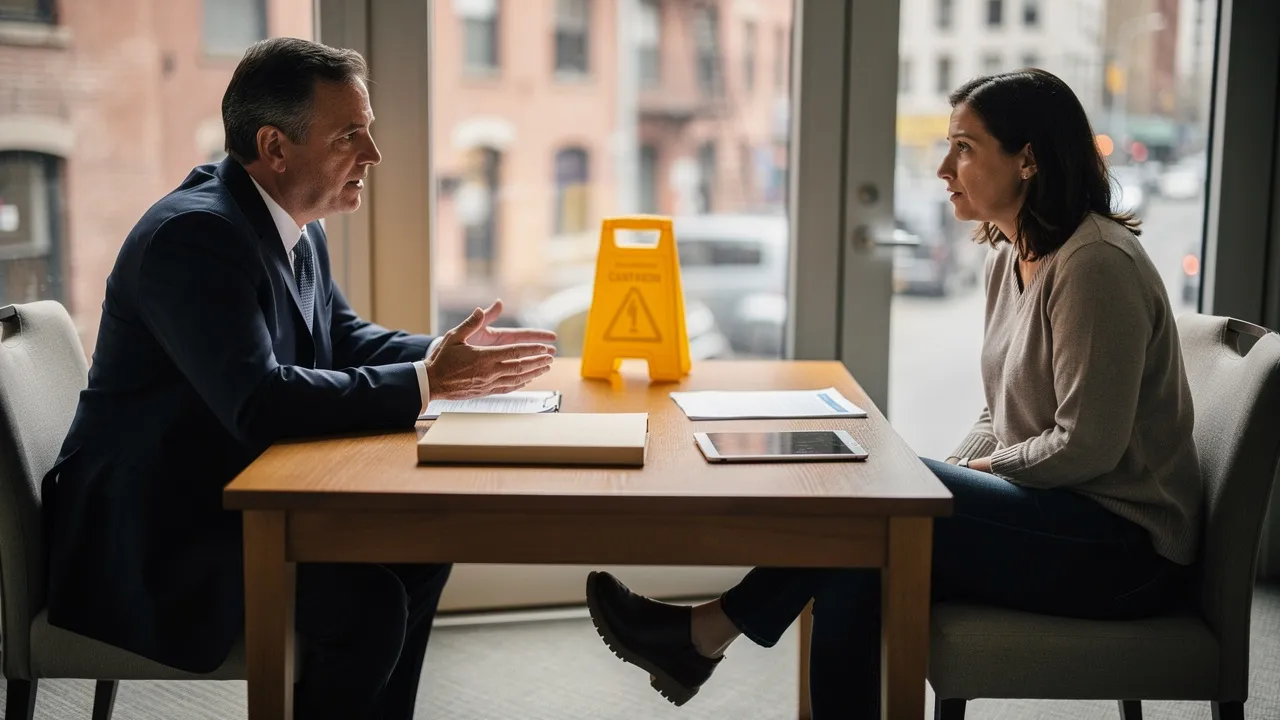
Start with the location, the apparent property controller, and whether the site was private, municipal, an authority property, or a state highway. Only a qualified New York attorney reviewing your specific facts can assess your claim, applicable deadlines, and available options. Bring your timeline, records, photographs, and questions so you can discuss the potential premises matter with Bergman, Bergman, Fields & Lamonsoff, LLP.
What should you ask during a New York premises liability consultation?
When should I contact a premises liability attorney New York after an injury on public property?
Contact a qualified New York attorney promptly when the injury involves a sidewalk, public housing, transit facility, state highway, or another government-related location. A notice of claim generally must be served within 90 days when required, and the correct public defendant, recipient, hearing requirement, and lawsuit deadline depend on the facts.
Where should a New York City premises-injury notice of claim be served?
A New York City tort notice is generally submitted before suit and properly served within 90 days of the occurrence. However, claims against listed authorities - including NYCHA, the New York City Transit Authority, and the MTA - generally must be served on the authority or its designated agent rather than the Comptroller’s Office. Confirm the public defendant and recipient promptly.
Can a storm affect an indoor slip-and-fall claim in New York?
It can. New York’s storm-in-progress defense may apply indoors as well as outdoors when snow or moisture has been tracked inside from outside. Record the timing and source of the moisture, weather conditions, warnings, mats, cleanup, and any changes to the area; the effect of the defense depends on the facts.
What should a New York personal-injury contingency agreement explain?
It should state the percentage charged if money is recovered, what type of recovery it applies to, and how case-related costs and expenses are handled. Personal-injury cases commonly use contingency arrangements, but ask what happens to expenses if there is no recovery and when the percentage is calculated before signing.
Keep reading
More on Slip & Fall
 Slip & Fall
Slip and Fall Injury: What to Do After a Fall in New York
Learn what to do after a slip and fall injury in New York, when to seek care, preserve evidence, and consider legal review.
Read article Slip & Fall
Slip and Fall Attorney Los Angeles: How to Prepare for a Consultation and Compare Your Options
Prepare for a Los Angeles slip-and-fall consultation by organizing evidence, checking timing, comparing attorneys, and understanding fees.
Read article Slip & Fall
How to Choose a New York Trip and Fall Attorney: A Consultation Decision Guide
Learn how to choose a New York trip and fall attorney, preserve evidence, compare fees, and prepare for a focused consultation.
Read articleHurt like this?
Tell us what happened.
We handle Slip & Fall cases across Long Island, Queens and New York City. The consultation is free and you pay nothing unless we win.
- Answered 24/7
- No fee unless we win
- Hablamos español
Send us the details
Takes about a minute. Free and confidential.