Car Accidents
How to Choose a Nearby New York Car Accident Law Firm After an Injury
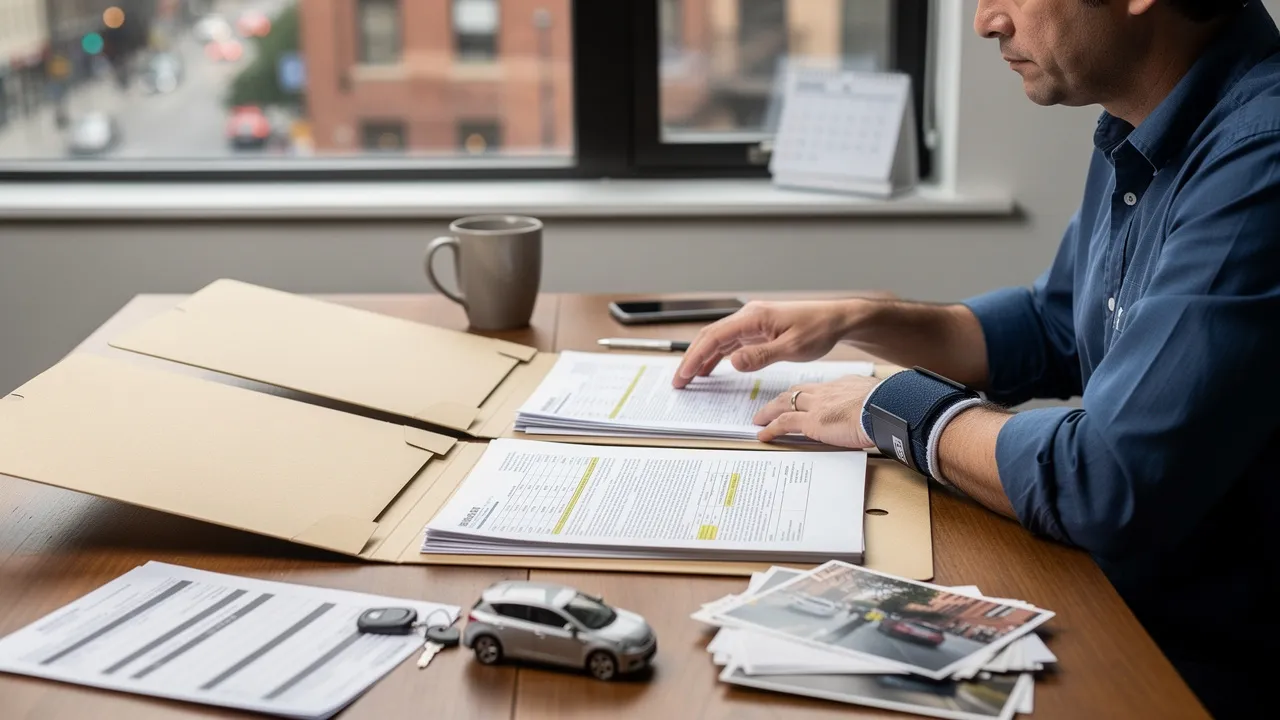
Use a documented-fit screen before contacting a New York car accident firm
A documented-fit screen helps you decide whether a nearby New York car accident practice belongs on your consultation list. Proximity alone does not answer whether our stated services address your type of collision, whether your injury questions require case-specific review, or whether you can prepare enough information for a useful first discussion.
Use these checks before you submit your contact information:
- Identify your role in the collision: driver, passenger, or pedestrian.
- Match the accident and injury description to the New York auto-accident services we state we provide.
- Compare Hicksville and Kew Gardens with your location and practical travel needs without assuming either office is nearest for you.
- Gather the accident, treatment, insurance, and work-impact records that can make the consultation specific.
- Write down the questions that general information cannot answer, including timing, fees, and whether we would accept the matter.
The decision is not whether you can predict eligibility, claim value, or a result from a website. The decision is whether the available fit information gives you a reasonable basis to request case-specific review.
Your first contact can be more useful when you separate facts from questions. Write down what happened, what role you had, where the collision occurred, what injuries you are treating, and what insurance communications you have received. Then list the points that remain unresolved, such as which No-Fault insurer should receive a notice, how we would organize the injury record, and what fee arrangement would apply if we accepted the matter.
A nearby location can be convenient without being a conclusion about your case. Treat location as one factor in a wider fit screen. Treat a consultation as the place to discuss facts that cannot be resolved by a general description.
A short opening summary is enough to begin: state the accident date and location, your role, the immediate injury information you know, and the most urgent question you need answered. Keep the summary factual. You can add detail after the basic fit questions are clear.
Match the accident and injured person's role to the firm's stated services
Your role in the collision should appear at the top of your consultation notes. A driver, a passenger, and a pedestrian can face different insurance-routing questions even when the crash occurred at the same intersection. We manage No-Fault paperwork, insurance issues, and the serious-injury requirement in New York auto-accident cases. That makes a New York injury collision an appropriate subject for an initial fit discussion, while your exact facts still need review.
Write one plain sentence about the event: you were driving, riding as a passenger, or walking when a vehicle struck you. Add whether the collision involved a car or truck, whether you received medical treatment, and whether you have already communicated with an insurer. Clear role information helps keep the initial discussion focused on the right insurance and injury questions.
Include the basic setting as well. Note whether the crash happened on a local street, highway, parking area, or another location, but do not try to classify fault in your first summary. Your purpose at this stage is to identify the people, vehicles, injuries, and unresolved questions.
A pedestrian collision should be identified separately from a vehicle-occupant collision. Bring that distinction to the consultation because it changes the insurance question you should raise, but it does not decide whether you have a viable injury claim.
Do not describe your role with a broad label such as car accident alone. State whether you were driving, riding, or walking, and preserve the names of the vehicles and insurers involved if you have them. If the facts are incomplete, label them as uncertain instead of filling the gap with an assumption.
If you were walking, identify the striking vehicle and any information you received about its insurer. Those details give the initial insurance discussion a more precise starting point.
Assess Hicksville and Kew Gardens as relevant contact locations
Our two full-service offices are located in Hicksville, Nassau County, and Kew Gardens, Queens. Those locations give you two contact points to consider when you are looking for service connected to Long Island or Queens. Office location is a practical fit question, not a promise that either address is the closest or most convenient for your particular home, workplace, treatment provider, or crash site.
Use your own travel and communication needs to assess the locations. If you live or work near Nassau County, compare the Hicksville office with the time required to communicate remotely. If you are based in Queens or elsewhere in New York City, consider whether Kew Gardens is a workable contact point. Your choice should reflect your circumstances rather than an assumption about distance.
The location of an office does not establish that we can take your case, determine how the facts will be evaluated, or predict a recovery. It answers a narrower question: whether contacting us through one of these locations is practical for you.
Your location check can stay simple:
- Note the county and municipality where the collision occurred.
- Note where you live, work, and receive treatment.
- Consider whether you need in-person contact or can organize the first discussion remotely.
- Record which location you want to ask about when you submit your contact details.
- Note any transportation, scheduling, or communication issue that could affect follow-up.
The office address does not answer whether your case would be accepted, how the facts would be evaluated, or what recovery might be available. Use location to decide whether contacting us is practical, then use the consultation to address the legal and factual questions.
Overview
The nearby-firm decision becomes clearer when you move from general search language to a short record of your situation. Your record should connect five subjects: the collision, your role, the injury, the insurance path, and the questions you want answered.
The order matters because each step supplies context for the next one. The collision record gives you a factual starting point. Your role helps frame the No-Fault question. Treatment and work-impact information show what you need to discuss. Insurance communications reveal what has already happened. Fee and language questions help you decide whether the contact process fits your needs.
This approach also keeps separate matters from being blended together. The date and location describe the event. Medical records describe treatment. Insurance documents describe communications and requests. Your questions explain what remains unclear. Keeping those categories distinct makes it easier to correct an incomplete detail without rewriting the entire account.
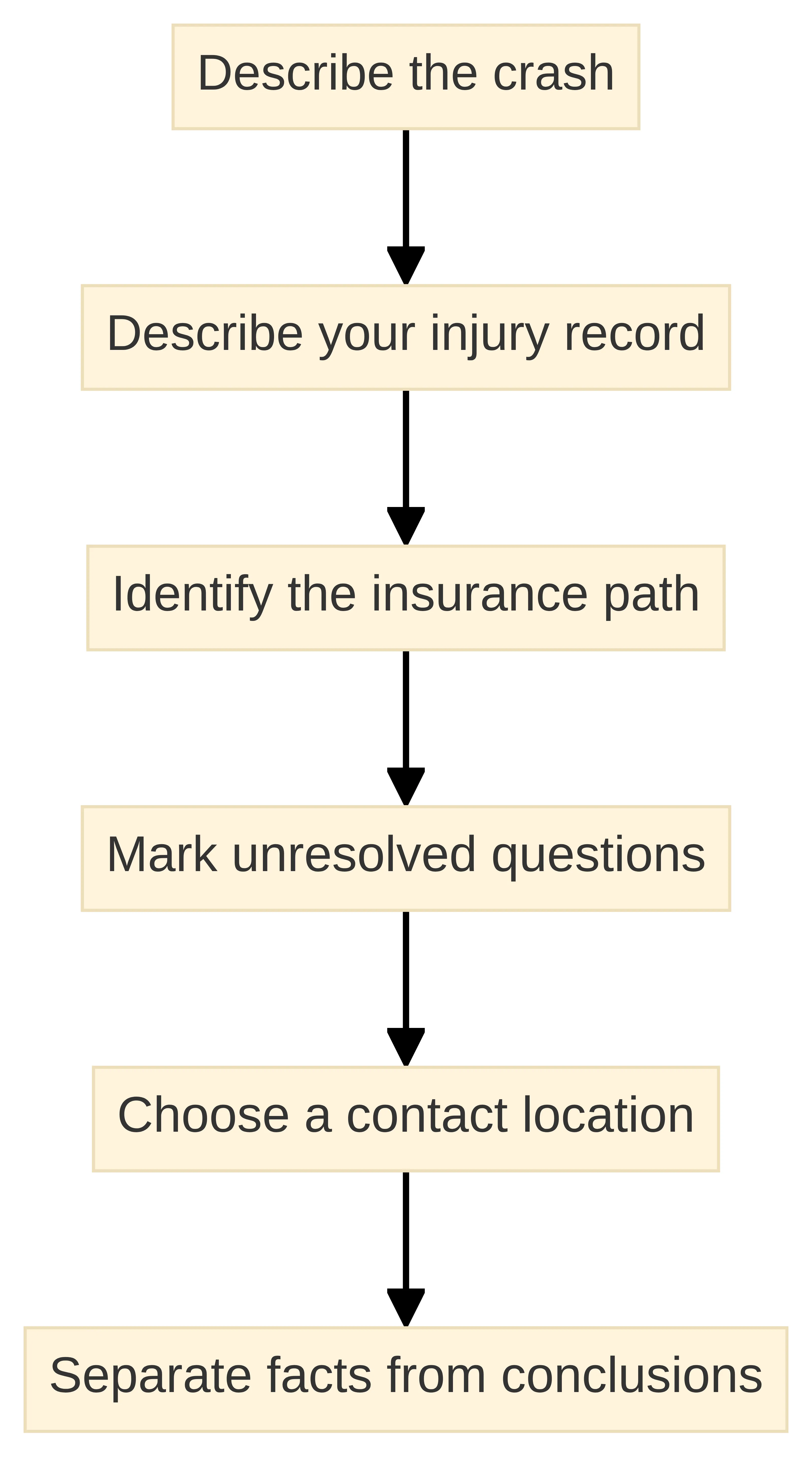
Use this sequence before requesting a consultation:
- Describe the crash. Record the date, place, vehicles, people involved, and any official or witness information you have.
- Describe your injury record. List treatment, providers, bills, restrictions, and changes in daily or work activities.
- Identify the insurance path. Gather policy information, claim numbers, letters, forms, and communications.
- Mark unresolved questions. Include timing, serious-injury issues, fee terms, language access, and whether the matter is within our intake scope.
- Choose a contact location. Use Hicksville or Kew Gardens as a practical contact consideration, without assuming either is nearest for you.
- Separate facts from conclusions. Label what you observed, what someone else told you, and what you still need to learn.
This sequence does not predict acceptance or value. It gives you an organized way to explain the situation and identify the questions that require legal review.
Use the firm's stated No-Fault and insurance support as a consultation question
Our stated New York auto-accident service includes managing No-Fault paperwork, insurance issues, and the serious-injury requirement. Use that description to form concrete questions rather than treating it as an answer about your own eligibility. You can ask how we would organize the insurance record, what documents we would want to see, and which parts of your injury history require closer review.
Bring every insurer communication you have, including claim acknowledgments, requests for information, benefit decisions, medical-payment correspondence, and messages about forms or deadlines. If you have not opened a claim or do not know which insurer is involved, write that down. An accurate unknown is more useful than a guessed answer.
Ask for a clear explanation of the next information we need from you. You can also ask which issue should be addressed first: No-Fault paperwork, treatment records, the serious-injury question, or another fact specific to the collision. The purpose is to organize the discussion, not to force a conclusion before the relevant records are reviewed.
New York Insurance Law § 5104 generally limits recovery for non-economic loss in covered motor-vehicle cases unless the claimant has a serious injury; the full statute, its exceptions, and your case-specific facts matter. The serious-injury question therefore belongs on your consultation list, but a symptom label or a general description cannot settle it.
Ask which medical records, treatment history, and functional information should be reviewed for that issue. Keep the question separate from the question of who pays medical expenses through No-Fault. Those subjects can overlap in a real claim, but they are not the same question. The consultation should address how they relate to the facts you provide.
Record the functional changes you noticed in ordinary language. Note activities that became difficult, treatment that followed, and restrictions documented by a provider. Do not use your notes to declare that a statutory threshold has been met; use them to identify the records and questions that need review.
Treat New York No-Fault timing as an urgent issue to verify
New York generally requires written No-Fault notice as soon as reasonably practicable and no later than 30 days after a motor-vehicle accident, subject to a documented justification for late filing. Record the accident date at the top of your notes and tell us whether 30 days have passed, whether notice was submitted, and whether you received a response.
Timing should be one of the first subjects in your contact request. Do not bury the accident date in a long narrative. Include it with your role, the vehicle involved, the insurer if known, and the date of any notice or claim submission.
If the date is uncertain, state the dates you do know and explain why the accident date is unclear. If notice was late, gather the submission date, the reason for the delay, and any written response. Those facts do not answer the legal issue by themselves, but they make the timing question concrete.
A New York Department of Financial Services FAQ describes Regulation 68, effective April 5, 2002, as changing the timeframes to 30 days for written notice, 45 days for medical bills, and 90 days for lost-wage claims. That historical description does not replace a review of the requirements that apply to your accident and the documents you need to submit.
Use the dates as questions to verify, not as a reason to make a definitive conclusion about your claim. If a notice, medical bill, or lost-wage submission may be late, include the relevant date and any explanation in your organized record. A consultation can then focus on the actual timeline instead of a general deadline question.
Do not postpone contact while trying to resolve the timing issue alone. Put the known dates in your request, identify the missing dates, and ask which deadline questions need immediate attention for your circumstances.
Check which insurer generally receives the No-Fault claim
The vehicle position you occupied generally determines the first No-Fault insurer to identify for a New York accident. If you were in a vehicle, the claim generally goes to that vehicle’s insurer. If you were a pedestrian, the claim generally goes to the insurer of the vehicle that struck you.
Write down the vehicle owner, driver, policy information, and insurer name if those details are available. If several vehicles were involved, list each one instead of selecting an insurer from memory.
A police report, insurance card, claim letter, or message from an insurer may help you organize these details. Keep the document that supplied each piece of information, and distinguish an insurer you contacted from an insurer that acknowledged or denied a claim.
Your insurer record should distinguish what you know from what you have been told. Note the claim number, date of each call or letter, name or department of the insurer contact, and any requested form or document. Preserve copies of what you sent and received.
The general routing rule does not resolve every insurance circumstance. Use the consultation to identify the correct filing path for your facts, especially if the vehicle information is incomplete, the accident involved several vehicles, or you were walking rather than occupying a vehicle. Do not delay organizing the record while you try to reconstruct every detail.
If you already submitted information to an insurer, include the submission date and retain the confirmation. If you have not submitted anything, say so plainly. The distinction helps us focus on the next question instead of assuming that a claim has already been opened.
Prepare the accident and evidence record before requesting a consultation
Your accident record should show what happened, what injury followed, and what property or expense information exists. Medical bills, police reports, insurance records, and injury-related expense documents can help show the accident, the resulting injury, and the damage or costs connected with it.
Create a chronological file with these items where available:
- The date, time, and location of the collision.
- The names and contact details of drivers, passengers, pedestrians, and witnesses.
- Vehicle descriptions, license information, photographs, and visible damage records.
- The police report or other official incident record.
- Insurance cards, claim numbers, forms, letters, emails, and text messages.
- Receipts or other records for accident-related expenses.
- A short note identifying what you personally observed and what came from another person.
Do not discard an item because it seems repetitive. Label duplicates and keep the original dates visible.
After assembling the file, create a simple evidence index. For each item, record its date, source, category, and status. The source might be your own observation, a police or incident record, a medical provider, a witness, an insurer, or an employer. The status can show whether the item is available, requested, incomplete, or uncertain. This index lets you see what supports the basic account and what still needs follow-up without treating an organized file as proof of a legal conclusion.
Use the index to separate four kinds of information:
- Event information: dates, location, people, vehicles, witness details, and official records that describe the collision.
- Injury information: symptoms you reported, providers, treatment dates, bills, restrictions, and other records connected with care.
- Insurance information: policy details, claim numbers, notices, requests, responses, and the dates of communications.
- Impact information: missed work, changed duties, altered routines, and documents that correspond to those changes.
For each important entry, add a short note explaining what it says and what it does not answer. An insurer letter may show that a communication occurred without resolving whether the insurer is the correct one. A treatment record may document care without deciding how a legal requirement applies. A work record may show a changed schedule without assigning a value to that change. Keeping those limits visible helps prevent one document from being used to answer a question it was not created to answer.
Compare the index with your unresolved-question list before you contact us. Mark any conflict rather than choosing the version that seems most favorable. If two dates differ, preserve both entries and identify where each date came from. If a record uses a term you do not understand, copy the term accurately and mark it as a question instead of translating it into a diagnosis or legal conclusion. If an item is missing, record the request date or the person who may have it when that information is known.
A consultation packet does not need to be perfectly complete. It should make the known facts easy to find, show which records support them, and identify the gaps that require discussion. Put the accident date, your role, the injury or treatment status, the available insurer information, and the most urgent unresolved question at the top of the index. Then keep the supporting documents in the same order as the summary. This gives the initial discussion a clear path while leaving eligibility, deadlines, serious-injury questions, fees, and acceptance for case-specific review.
Your preserved record should include documents, witness information, medical records, and communications with insurers while the crash, treatment, and work-impact questions are reviewed. Store digital files in a place you can access, keep paper documents together, and use a simple file name that includes the date and subject.
A short factual timeline can be more useful than a long account written from memory. Start with what you observed, then add what you learned from police, medical providers, witnesses, and insurers. Mark information that came from someone else. Avoid changing a photograph, deleting a message, or rewriting a record to make the sequence look cleaner.
Add a gap list to the file. Identify a missing police report, an unavailable photograph, an unanswered insurer letter, or a medical record that has not arrived. A gap list gives you a practical set of follow-up questions and prevents an absent document from being mistaken for an absent event.
Gather injury, treatment, insurance, and work-impact details
Your injury and treatment record should connect symptoms to dates and care without trying to decide the legal meaning of those facts. List the body areas affected, the date symptoms began or changed, the providers you saw, the treatment received, and the bills or statements you have. Include prescriptions, referrals, follow-up appointments, and restrictions when they appear in your records.
Bring the documents rather than relying on a general statement such as I was hurt. Medical bills and other injury-related expense records can help show the treatment and costs connected with the collision. Your notes should also identify gaps, such as a missing bill, a provider whose records have not arrived, or an appointment you could not attend.
Keep a simple treatment chronology. For each entry, record the date, provider, reason for the visit, treatment described in the record, and any next appointment. Use the provider’s wording for diagnoses and restrictions rather than adding a diagnosis of your own.
Your work-impact record should explain what changed after the collision. Note missed shifts, reduced hours, modified duties, time spent traveling to treatment, and communications with an employer or benefits administrator. Preserve wage records or other documents that show the dates you are describing when those documents are available.
Keep work impact separate from medical diagnosis. State what you could not do, what changed in your schedule, and which document supports the entry. If you are self-employed, describe the interrupted work or appointments in the same factual way. This record gives you a focused starting point for questions about insurance, treatment, and the effect of the injury.
Include changes in ordinary activities as well as employment. Note transportation difficulties, household tasks that changed, or appointments that affected your schedule when those details are relevant to your account. The purpose is to preserve the effect of the collision in dated, specific terms, not to assign a legal value to each entry.
Verify fees, language access, and whether the case would be accepted
We offer free consultations for accident victims. A free consultation is a way to discuss your facts and questions; it is not a promise that a case will be accepted or that a particular result will follow.
If you are considering a contingency arrangement, ask for a written fee agreement before proceeding. The written agreement should explain the fee arrangement and related terms clearly. A general explanation of contingency fees does not promise that any lawyer will accept your case. Put fee questions in your notes so they are addressed directly rather than inferred from general website language.
Ask which expenses, responsibilities, and stages of representation the written agreement addresses. Do not rely on a verbal summary when the matter moves forward. The written document is the place to understand the arrangement before you decide whether to proceed.
Language access should be part of your practical fit check. If you need Spanish-language communication or another accommodation, state that need when you contact us and ask what communication support is available for your matter. Make the request before relying on an assumption about how communication will work.
Ask whether we would review your type of collision, whether the available information is enough for an initial evaluation, and what additional records we would need. Do not treat a consultation request as an acceptance decision. Your role is to provide accurate contact information and accident details; our review must determine whether we can take the matter.
You can also ask who will be your main contact, how you should send additional documents, and what information would make the initial review more complete. These are practical questions about communication and intake. They do not require you to predict the legal result of your case.
Key Highlights
The nearby-firm choice can be reduced to a short set of documented questions. Use the checklist below after you have assembled the basic record and before you submit your contact information. Each item should point to a fact, a document, or a question rather than a prediction.
- Role and collision: Have you stated whether you were driving, a passenger, or a pedestrian, and have you identified the date and location?
- Service fit: Does your description concern a New York auto-accident injury, and have you written the insurance and serious-injury questions you need to discuss?
- Location: Have you considered Hicksville in Nassau County and Kew Gardens in Queens without assuming either office is nearest for you?
- Timing: Have you recorded the accident date, any No-Fault notice date, and any medical or wage-submission dates that may matter?
- Insurer: Have you identified the vehicle you occupied or, if you were a pedestrian, the vehicle that struck you?
- Evidence: Have you gathered the police report, photographs, witness information, medical records, bills, expense documents, and insurer communications available to you?
- Treatment and work impact: Have you organized provider information, treatment dates, restrictions, missed work, and other dated changes?
- Terms and communication: Have you listed your fee, language-access, contact-person, and case-acceptance questions?
- Unknowns: Have you marked missing documents and uncertain details instead of silently filling the gaps?
A completed checklist does not predict your eligibility, value, or outcome. It gives you a concise record for a more focused conversation.
Request a focused consultation with the organized record
A prepared consultation request should include your name and contact details, the accident date and location, your role, a brief description of the collision, the injuries and treatment you know about, the insurer information available to you, and the questions you want answered. Mention whether you were driving, riding, or walking, and identify any timing concern at the start.
We manage No-Fault paperwork and insurance issues in New York auto-accident cases. Use your organized record to make that review specific rather than relying on a prediction from general information.
Send the facts you can support and identify what remains uncertain. Include copies or summaries of the documents that explain the accident, treatment, insurance communications, and work impact. Keep your own copies and note the date of your request.
The organized record gives you a practical starting point: a clear account of the collision, the documents connected with your injury, and a short list of unresolved questions. Submit accurate details and keep copies of what you provide. A focused request lets you discuss fit, timing, insurance, communication, and fee questions without treating general information as a decision about your case.
What should an injured New York driver, passenger, or pedestrian confirm during the consultation?
How can I prepare for a consultation with the firm?
Gather details about the accident, including the date, location, your role, treatment received, insurance communications, and any questions you have about the process.
Does the firm offer consultations for accident victims?
Yes, the firm offers free consultations for accident victims to discuss their cases and gather necessary information.
What should I include in my accident record before contacting the firm?
Your accident record should include the date and location of the collision, details of the vehicles and people involved, medical treatment received, and any insurance communications.
Where are the firm's offices located?
The firm has two full-service offices: one in Hicksville, Nassau County, and another in Kew Gardens, Queens.
What should I ask about the firm's fee structure during the consultation?
Inquire about the written fee agreement, what expenses are covered, and how the contingency fee arrangement works.
Keep reading
More on Car Accidents
 Car Accidents
4 Steps to Choose the Right Car Accident Advocate for You
Discover how to choose the right car accident advocate to support your recovery journey.
Read article Car Accidents
How to Handle Rental Car Accidents: Essential Steps to Follow
Learn essential steps to manage rental car accidents effectively and protect your rights.
Read article Car Accidents
4 Steps to Choose the Right Attorneys for Automobile Accidents
Learn how to choose the right attorneys for automobile accidents in four simple steps.
Read articleHurt like this?
Tell us what happened.
We handle Car Accidents cases across Long Island, Queens and New York City. The consultation is free and you pay nothing unless we win.
- Answered 24/7
- No fee unless we win
- Hablamos español
Send us the details
Takes about a minute. Free and confidential.